

| Piece count | |
|---|---|
| Brand | |
| Artist | |
| Art museum | |
| Dimensions of the work | 244 x 234 cm |
| Art movement | |
| Difficulty | |
| Puzzle Dimensions | 86.36 x 39.37 cm |
| EAN | 628136658515 |
5 reasons to choose our art puzzles




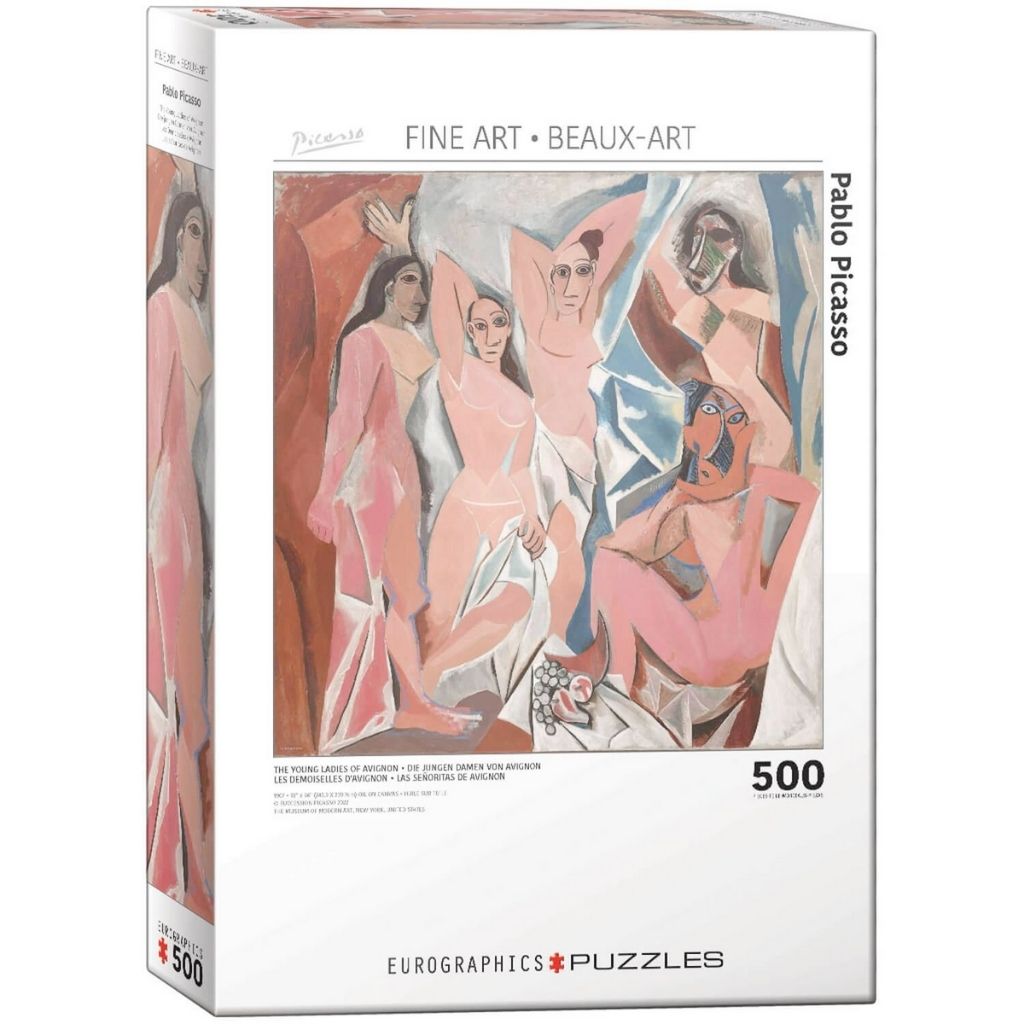
Home / Shop / Avant-garde art puzzle / Picasso’s Rose Period – The Young Women of Avignon, 500 pieces
25,00€
25,00€
Out of stock
This 500-piece puzzle dedicated to Picasso’s Rose Period invites you to explore a key phase in Pablo Picasso’s artistic research, in which color, the human figure, and emotion take center stage.
With its 500 pieces, the puzzle offers an accessible yet visually rich challenge, perfect for a leisurely approach to Picasso’s art. Once completed, it can be framed and becomes an elegant decorative element, bringing the chromatic sweetness and emotional depth of one of the most moving periods of modern art into your home.
A puzzle designed for those who seek beauty , silence and meaning , and for those who believe that art is also a time to be inhabited, slowly.
The image details are of excellent quality , furthermore the die is made with Smart-Cut Technology with unique and unusual shapes and just like snowflakes, no two pieces are the same.
The highest quality product is 100% recyclable, environmentally friendly and non-toxic.
This puzzle is currently out of stock.
In the meantime, discover some other art puzzles you might enjoy.

With Puzzle Art you can discover the Guernica puzzle !
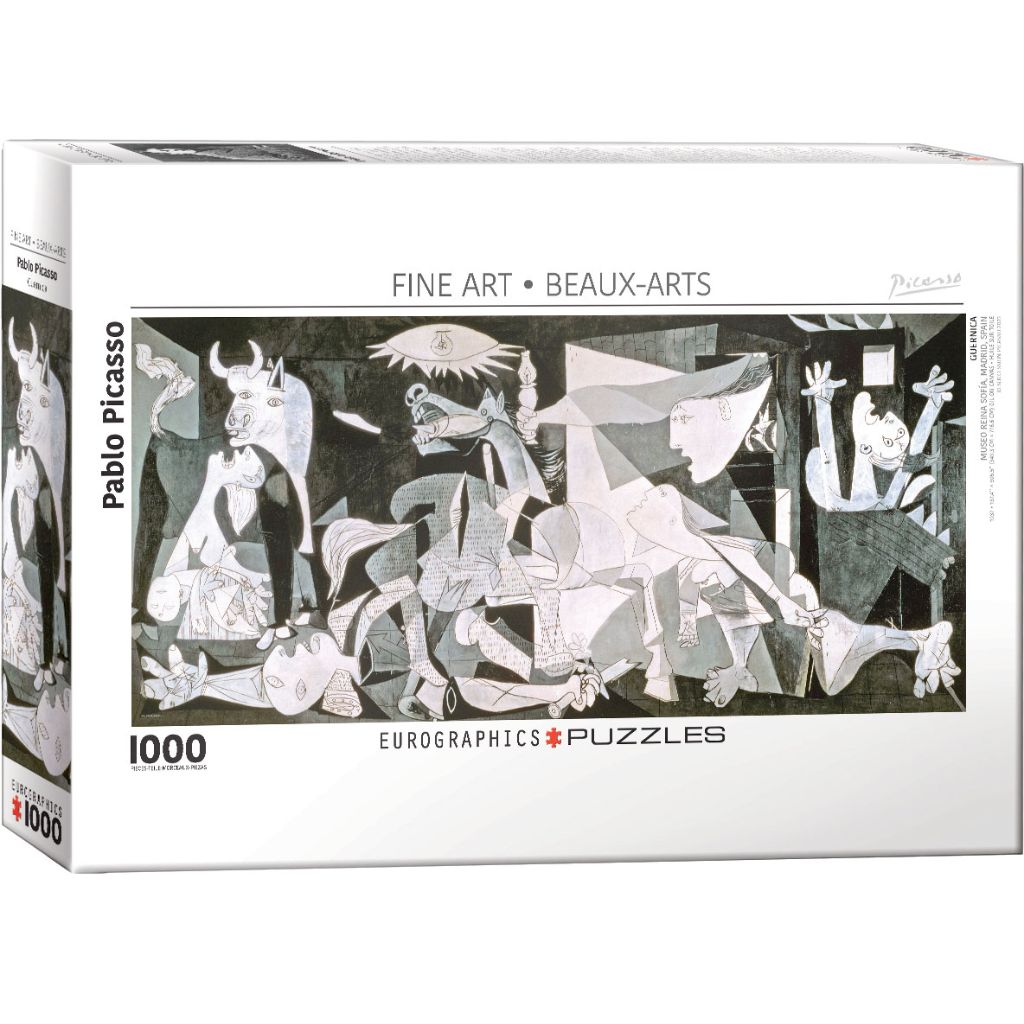
Piece by piece, reassemble Picasso’s magnificent work “Guernica” in the 1000-piece panoramic version from the Canadian brand Eurographics.
Reconstruct all the scenes of the most powerful painting about the war by the great master of twentieth-century art: Pablo Picasso . In the details of this painting you will discover the history and tragic events of the War , so as not to forget.
The 1000-piece Picasso “Guernica” puzzle from Eurographics is a truly powerful and meaningful puzzle.
The subject expresses all the vital force of the Spanish master in the use of forms and his great ability to combine them as if they were parts of the same scene.
The Guernica puzzle image is quite easy to complete, perhaps with the help of your children or older children, who could use this painting to develop an intimate and engaging relationship with the story’s events.
 |
Number of pieces 1000 |
 |
Brand Eurographics |
 |
Puzzle dimensions (cm) 86.36 x 39.37 |
 |
Box dimensions (cm) 35.36 x 25.4 x 6 |

Scatola ben rifinita
Splendida idea regalo
Capolavoro d’arte
Colori e dettagli di qualità
1000 pezzi
Formato panoramico
We chose the Guernica puzzle to discover, piece by piece, the emotional strength of the Cubist works of the greatest painter of the twentieth century .
Guernica is one of the most important paintings of the twentieth century. It captures all the violence and destruction of war in a single image.
In his paintings, Picasso wanted to express all the strength that life and the experiences he saw through his eyes brought to him. This is why the horrors of war, imprinted on his eyes during the bombings, inspire this painting, which is nothing less than a manifesto against the atrocities of the bombings .
In 1937, in the midst of the Spanish Civil War that the Francoists, supported by the Nazi-Fascist forces of Germany and Italy, had unleashed against the legitimate government of the country, Picasso was shocked by the news of the bombing of the Basque town of Guernica.
To the obtuse exterminating fury of that terrorist action aimed above all against the defenceless population, on market day, the artist responds by creating in just two months the enormous canvas entitled Guernica, a true indictment against the war and the dictatorship.
The work, symbolically exhibited in the Spanish Pavilion at the 1937 Universal Exhibition in Paris, caused a sensation and emotion in the free world.

Guernica, whose very size (3.5 metres high and almost 8 metres long) reveals its function as an ideological and political manifesto, designed to be viewed simultaneously by the greatest possible number of people, constitutes one of the highest and most inspired synthesis points of all Picasso’s art.
The painting depicts the dramatic moment of the bombing. Color, synonymous with life, is abandoned in favor of a gloomy black and white, and the figures appear like screaming ghosts, suddenly illuminated by the sinister flashes of the explosions.

The composition, apparently chaotic, is actually organised into three vertical bands: two narrower lateral ones, equal to each other, symmetrical to the wider central one, where the greatest number of characters are crowded together.
The setting is simultaneously interior (as suggested by the chandelier hanging high above, near the center of the painting) and exterior (as suggested by the burning building on the far right). This contemporaneity of vision is not merely Cubist; it seeks to render with violent realism the tragedy of the bombing that suddenly destroys and demolishes entire buildings, mercilessly scattering even the most intimate belongings of each family into the open. In this chaotic and undifferentiated space, men, women, and animals flee and scream like madmen, overlapping and intersecting, united by the same pain and the same violence.
On the far left, a mother cries out agonizingly as she clutches the body of her young son. On the opposite side of the canvas, another figure echoes her desperate cry, raising his hands to the sky. In the center, a wounded horse, a symbol of the Spanish people, neighs painfully, extending a tongue as sharp as a shard of glass.
Everywhere there is only death and destruction, underlined by a hard and almost sharp design, which also makes the rays of the chandelier look like small, sharp swords.
Whoever can, tries to escape, like the woman who, from the lower right corner, throws herself diagonally towards the bull, in the upper left corner, a symbol of violence and bestiality.
On the ground, amid the rubble, we witness the horror of the mangled corpses. On the left, an outstretched hand, with the lifeline symbolically broken into small segments, symbolizing the lives lost to the horrors of war. In the exact center of the painting, another hand still clutches a broken sword. Finally, in the background, an intact flower: a symbol of hope, of life, and of reason, which, despite everything, will prevail over death and barbarism.
In this painting, preceded by at least fifty preparatory sketches and drawings, Picasso perfectly transcends and merges the two phases of Analytical Cubism and Synthetic Cubism. Everything is movement, convulsion, drama. Those gnashing mouths turned to the sky scream pain and vengeance, and the abrupt alternation of light (white) and shadow (black and the entire spectrum of grays) emphasizes the sinister succession of explosions and the sudden flare-up of fires.
In this making audible, through the tools of painting alone, the roar of war and the cries of the innocent victims lies the whole character and greatness of the mature Picasso, who does not hesitate to side with democracy and civilization,
Once again, in Picasso, Goya’s teaching, to which the Catalan artist never ceased to feel intimately indebted, becomes extraordinarily relevant: “The sleep of reason generates monsters.”
Thanks to our 1000-piece version of the Guernica puzzle, you can relive all the power and expressive power of abstract art by building this timeless masterpiece piece by piece.

Congratulations!
You have a passion for art!
You have made it this far, so here is a treat!
Get 10% off your next masterpiece! ✨
Nessun termine trovato.
Nessun termine trovato.
Nessun termine trovato.
Nessun termine trovato.



 Hot
Reviews
There are no reviews yet.