Home / Puzzle Arte blog / Art and painters / Landscape in Japanese prints: Hokusai and Hiroshige
Compare two landscapes. A mountain and a bridge in the rain offer different ways to observe distance and atmosphere.
Landscape in Japanese prints suggests both a place and a way to encounter it. Viewpoint, figures’ scale and lines guide the eye. Compare Hokusai’s Red Fuji and Hiroshige’s shower at Shin-Ōhashi bridge: each constructs a distinct relationship between environment and viewer.

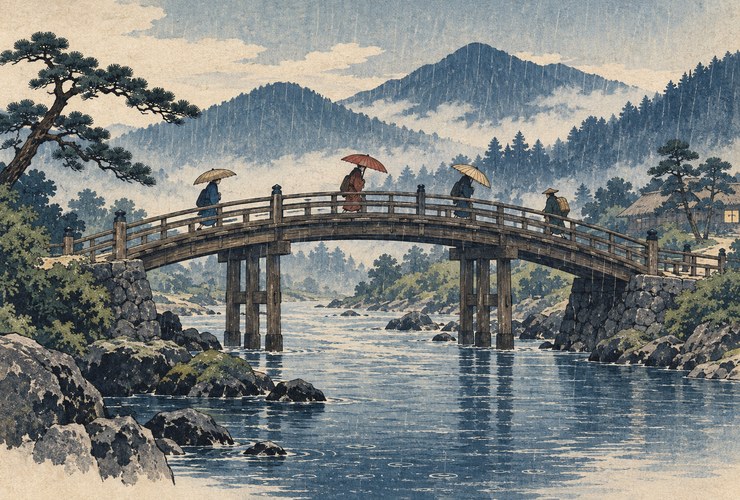
Utagawa Hiroshige, Sudden Shower over Shin-Ōhashi Bridge and Atake, 1857. The Metropolitan Museum of Art, JP2522, The Howard Mansfield Collection, Purchase, Rogers Fund, 1936.
The Met’s history of ukiyo-e discusses Hokusai and Hiroshige’s role in early nineteenth-century landscape views, often with seasonal themes.
Compare continuity and variation within a series. A mountain can seem near or distant, while a road emerges through travellers or surroundings. Both place and representational choices matter.
South Wind, Clear Sky, known as Red Fuji, belongs to Thirty-six Views of Mount Fuji. The Met dates its colour woodblock impression to about 1830–1832. The mountain dominates without human figures; small tree marks and clouds introduce contrasting scales.
Follow the mountain’s profile, then compare broad slopes with details at its base. Return to the sky and consider how it participates in the composition.
The 1857 Sudden Shower over Shin-Ōhashi Bridge and Atake belongs to One Hundred Famous Views of Edo. The Met’s record describes thin rain lines over the Sumida River bridge. This article’s print reproduction shows that museum impression; its cover is an editorial illustration.
Compare the rain’s direction with the bridge’s diagonal. Small pedestrians suggest crossing and movement, while the distant shore changes your reading of the foreground.
In Red Fuji, the mountain presents a large continuous form. Hiroshige distributes attention through pedestrians and rain. Describe where your eye begins, which line it follows and what suggests distance.
Landscape is not necessarily tranquil, and few subjects need not mean few relationships. Scale, rhythm and areas of colour offer distinctions beyond a broad “nature” label.
Look at the actual reproduced subject. Bridges, mountains and waves offer long lines, broad areas, small figures or repeated details. Compare these with an edition’s dimensions and piece count.
Explore available subjects in our Hokusai collection and Japanese puzzles collection. The two prints discussed here provide an editorial comparison rather than a claim that both are sold as puzzles. Continue through our Japanese art collection.
Lines and colour areas also result from a printing process. Read how an ukiyo-e print is made for design, blocks and registration, or compare Hokusai and Monet.
Return to museum records for questions about date, medium and the particular impression. They connect visual observation with an object’s history.
Context, works and Hiroshige reproduction: Metropolitan Museum of Art, records JP2960 and JP2522 and its ukiyo-e essay, consulted 8 October 2026. Comparative exercises are editorial suggestions.
Nessun termine trovato.
Nessun termine trovato.
Nessun termine trovato.
Nessun termine trovato.