Home / Puzzle guide: choose, complete and enjoy your puzzle / How to organise puzzle pieces
Organising puzzle pieces means creating an order that helps you search. A few groups, somewhere for uncertain pieces and a surface to see candidates without overlapping them are often enough. The best arrangement makes your next step easier.
Distinguish initial sorting, reorganisation during assembly and storage between sessions. Recognisable objects, shades, lines or piece outlines may become useful at different stages. There is no ideal tray count or universal grouping. Consider your available space and the finished dimensions before buying accessories, especially if the table serves other purposes.
Consider the criteria and adapt the approach to your project.
Weigh up the options and preserve what the experience means to you.
Divide the space between the growing image, pieces to search and the reference picture. If the finished puzzle fills the surface, plan additional space or a system for storing some groups. Loose pieces piled on the assembled image make it harder to see and easier to knock.
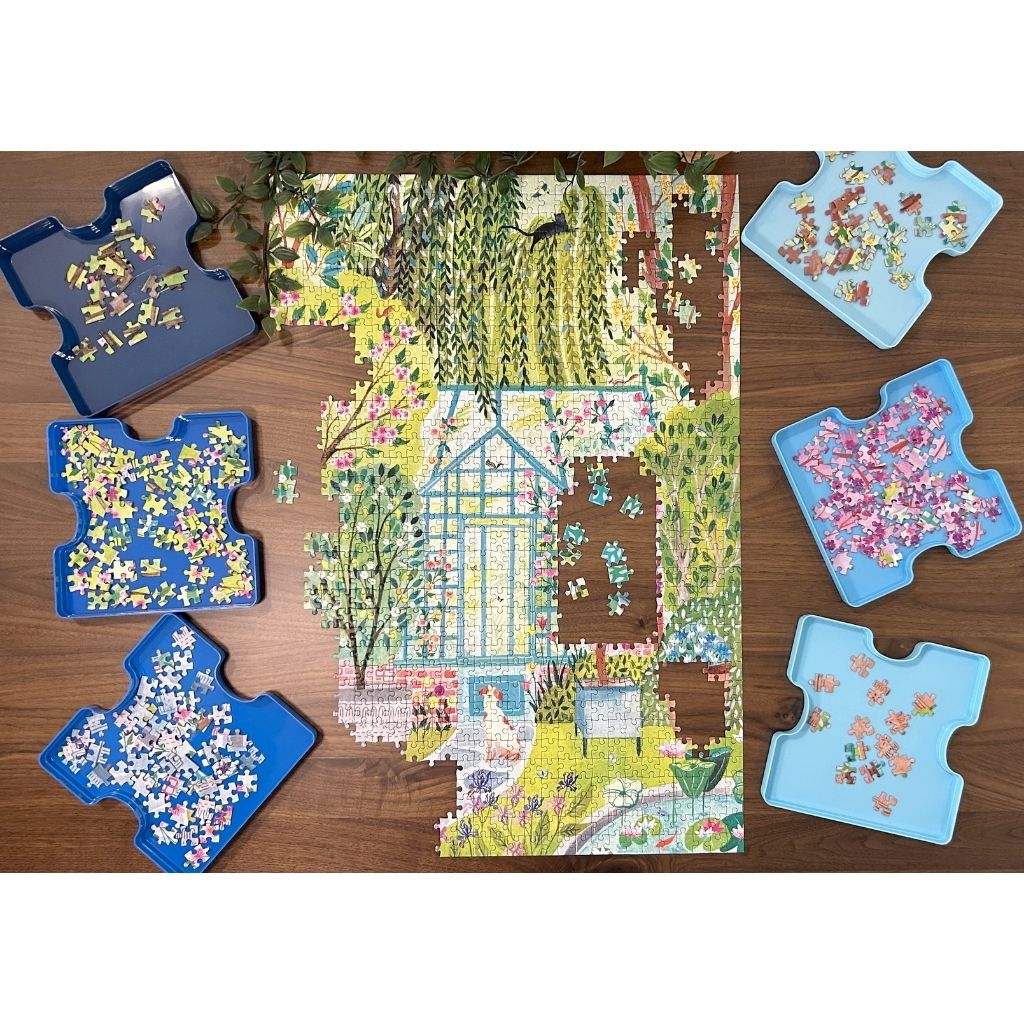
Use shallow containers where they improve visibility. Trays, clean box sections and boards can hold pieces temporarily, show candidates or store work. Avoid deep layers. With limited space, keep the active area visible and leave the rest accessible in the box. A manageable partial arrangement is more useful than a complete system you cannot maintain.
Colour sorting helps when a shade belongs to a recognisable area, but the same green can appear in leaves, clothing and decoration. Compare texture and outlines too. A distinct green-and-white boundary may be more informative than a plain green piece.
Windows, flowers, faces, lettering and animals offer recognisable groups. Stone, water, fabric and brushstrokes suggest textures. Combine criteria without demanding perfect boundaries: “wall and windows” may help more than many small colour groups. Keep transition pieces near their likely area. A label should describe a useful search rather than a certainty you do not yet have.
The Jig & Puz sorter contains six stackable 20.5 × 20.5 cm trays. They can separate small groups by colour, shape or detail between sessions. Consider capacity and available space: sorting every piece is optional, and trays are not essential.
You need not study every unrecognisable piece during the first sort. Keep uncertain candidates together and begin with clearer clues. Once an object takes shape, return to them: previously anonymous details may become understandable.
Keep this group accessible and distinct from pieces excluded from a particular search. A piece wrong for one window may still belong to the building. Use flexible labels such as “to examine” and “candidates for this outline”. When working together, agree what groups mean. In art puzzles, colours and brushstrokes cross subjects, so update your selection without repeatedly undoing everything.
Good organisation reveals new possibilities.
Shape becomes useful when the picture offers few clues or a gap clearly defines the required piece. Look at tabs, sockets, proportions and orientation. Pieces with the same tab count still have different outlines.
Create a local selection for the current problem, then compare colour and picture continuity. Sorting the entire box by shape can be unnecessary early on. As sections connect, gaps become clearer and fewer pieces remain. Changing your sorting criterion reflects the information now available rather than an earlier mistake.
As areas emerge, some groups empty and others change meaning. Combine nearly empty containers, free the surface and separate transitions you now understand. Let the organisation follow your growing knowledge of the image.
A few minutes reorganising may help more than constantly searching for fits. Divide an overly broad group using a clear clue; combine categories that keep getting mixed. In a seascape, “all the blue” may become “pale sky”, “reflected water” and “boat edge”. Keep representative pieces visible. The system works when you know where to look.
Before storing your work, check that containers and boards cannot tip or mix groups. Stack trays according to their design without placing weight on pieces. Store assembled and loose pieces separately where the accessory requires it. Simple temporary labels can help.
A photograph or note of the active area makes returning after a long break easier. Check the arrangement before searching: movement can change it. If you clear the table nightly, choose a practical storage system. See the assembly process for context and piece counts and space for future projects.
Start with broad groups that reflect this particular picture. In a landscape, water, architecture and foliage may be useful; in a portrait, clothing, face and background may offer better distinctions. A piece crossing two areas belongs wherever you are most likely to find it when you need that boundary. You can move it later. Sorting is a way of reducing a search, so a category that contains almost everything may need subdividing, while several tiny groups may be easier to combine.
Leave enough room to inspect the pieces within each group. A crowded tray can hide the very colours and outlines you sorted it to reveal. Keep the picture sides visible where possible, and use a stable arrangement that can be covered or put aside according to the equipment you have. Do not assume that stacked trays or improvised containers will protect fragile assembled sections. Loose pieces and connected sections have different support needs.
Change your categories when the image supplies better clues. A group labelled blue may eventually separate into a roof, shadow and sky. Shape may become helpful once a gap is defined by several neighbouring pieces. Keep a small uncertain group rather than forcing doubtful candidates into a category. When returning after a break, review what each group means and whether it still helps you find pieces. The best organisation is one you can understand at the table, without spending more time maintaining it than assembling the picture.
If the puzzle needs moving between sessions, review how the groups will travel before adding more categories. Label a container in terms you will recognise later and keep any uncertain pieces visible enough to reconsider. Preserve the reference image with the work. Organisation should reduce the effort of returning to the project, rather than create a collection of piles whose meaning depends on remembering every decision from the previous evening.
Choose the next guide according to the question that matters to your project.
Adapt your approach to the image and consult any specific instructions supplied with your puzzle.
Nessun termine trovato.
Nessun termine trovato.
Nessun termine trovato.
Nessun termine trovato.