

Giveaway – Comment and win a puzzle
Home / Puzzle Arte blog / Art and painters / Ukiyo-e: how a Japanese woodblock print is made
Explore the technique. From a designed image to impressions on paper: understand a print through the work that makes it possible.
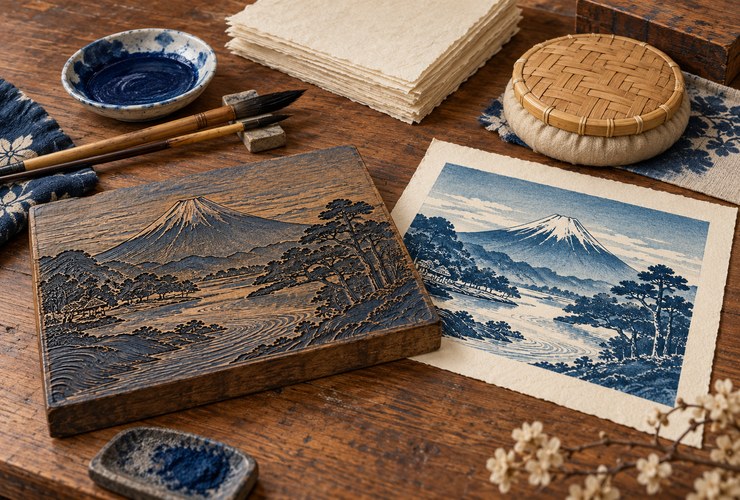
How is an ukiyo-e print made? An image associated with an artist also results from a process involving carved wood, paper and a printer’s work. Understanding these stages provides new questions about outlines, colour areas and gradations. Consider both what a Japanese print depicts and how that image becomes a physical object.
Editorial illustration created for Puzzle Arte to accompany this article.
Ukiyo-e is commonly translated as “pictures of the floating world”. The Metropolitan Museum of Art relates it to Edo-period culture, including actors, entertainment districts and later landscapes. Woodblock printing describes a production technique; the visual tradition and its technique are related but not interchangeable terms.
A museum label’s artist, title and medium answer different questions: who designed the image, what it depicts and how this particular impression was produced.
The Met’s essay on ukiyo-e woodblock prints distinguishes designer, carver, printer and publisher. A signature does not erase the contributions involved in carving blocks, transferring colour and producing and distributing prints.
These decisions must work together: a fine line must be carved, colours must meet the design, and paper must receive successive impressions.
Colour prints use separate blocks. Registration marks position paper accurately so successive colours align. Strong, absorbent paper must receive colour and withstand pressure.
Follow a colour area near a dark outline, then compare it with a broader patch. This observation distinguishes line and colour without claiming to diagnose material or print quality from a digital reproduction.
The Smithsonian describes a baren, used to rub the paper’s reverse against an inked block. Contact and pressure transfer the image.
A drawing, block and impression are different objects. A paper print results from this process rather than simply photographing a preceding drawing.
Blocks allow several impressions of an image. Museum records therefore identify a particular object by dimensions, provenance and accession number. Identical titles can describe different impressions.
Colour differences online may result from impression, condition or photography, with the screen adding another variable. Brightness alone cannot identify the most faithful image. Read object records alongside reproductions.
A modern puzzle reproduction is another object. Explore our Hokusai collection and follow line continuity during assembly. Foam, boats and sky provide different clues.
Return to museum sources for questions about construction. Continue with Hokusai and Hiroshige’s landscapes or Hokusai, Monet and Japanese art. Compare available editions in our Japanese puzzles collection.
History and technique: Metropolitan Museum of Art. Printing tool: Smithsonian Institution’s baren record. Sources consulted 8 October 2026. Observation exercises are editorial suggestions.
Nessun termine trovato.
Nessun termine trovato.
Nessun termine trovato.
Nessun termine trovato.