Home / Puzzle guide: choose, complete and enjoy your puzzle / Which glue should you use for a puzzle?
Which puzzle glue should you use? Consider the material, finish and intended result. A dedicated product is a starting point, but its name alone cannot establish suitability for every puzzle or mounting.
This guide focuses on product selection rather than the complete gluing procedure. Distinguish joining pieces, bonding a backing and changing the picture surface. Cardboard, print, wood and special effects respond differently. Look for stated compatibility and instructions rather than household recipes, universal dilutions or simply the strongest adhesive. For removable assembly, using no glue may be the right choice.
Consider the criteria and adapt the approach to your project.
Weigh up the options and preserve what the experience means to you.
Do you want to join pieces, attach a board or add a protective finish? Some products combine functions; others do not. Look for explicit intended uses and application sides.
A frame may need rigid backing regardless of how firmly pieces are joined. Glue for the picture face need not suit a board, while a backing adhesive need not suit print. Describe the puzzle’s material, dimensions, finish, backing and destination when asking for advice.
Look for declared compatibility. Printed cardboard differs from ordinary paper; wood, gloss, metallic effects and special coatings need specific consideration. Consult the puzzle maker’s instructions for unusual surfaces.
Transparency or fast drying does not explain how glue interacts with print and backing. Avoid treating craft recipes as guarantees. Ask when information is missing; a test on different cardboard cannot establish safety for a valued image. Distinguish the label’s claims from assumptions and informal recommendations.
Glue on the picture face can change its appearance. Check whether the finish is matt, glossy or otherwise altered. Lighting, glazing and a shiny print may create reflections absent on the table.
Choose with the subject and viewing conditions in mind while keeping compatibility the priority. Consider colours and textures in an art reproduction. No universal promise makes glue invisible or preserves the original appearance indefinitely. If permanent changes do not suit your aim, consider adhesive-free mounting.
Choose materials that respect your image.
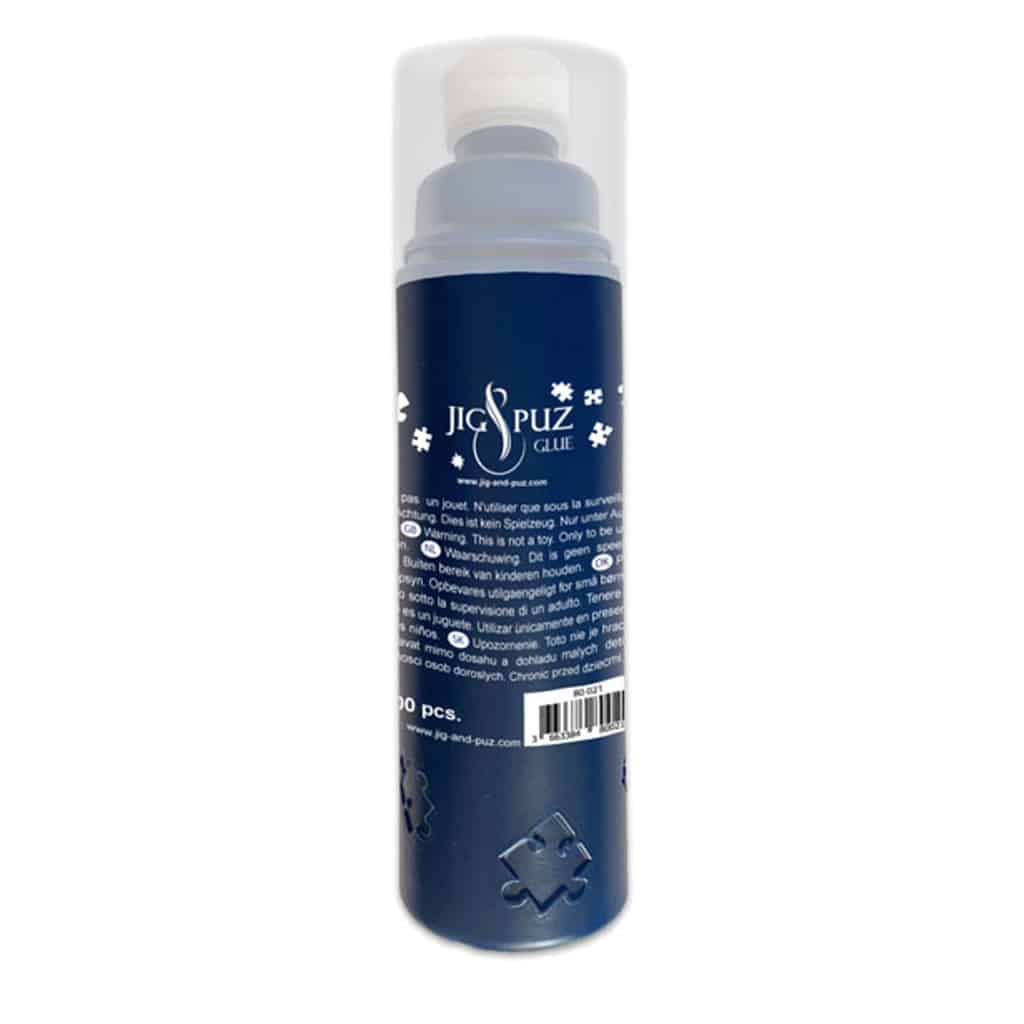
The 200 ml Jig & Puz glue has a sponge applicator and a glossy finish stated in its product description. It is intended for permanent fixing. Check material compatibility, application side and instructions before use.
Use the manufacturer’s coverage information and the actual surface area. Piece count may be a product reference but does not uniquely define dimensions. Check whether stated coverage includes one or more applications.
Use the intended sponge, brush or spreader. Extra glue cannot resolve uncertain compatibility. Plan quantities and drying times for the stated steps, without adding dilution or mixtures. Compare intended use, coverage, finish, applicator and times alongside package price.
Read instructions before buying where available and always before application. Check drying conditions, ventilation and tool cleaning. Keep labels and prevent unsupervised access by children and animals.
For previously opened glue, check storage limits and condition. Do not try to restore altered glue with water or other ingredients. A larger bottle is useful only if you can store and use the remainder appropriately. Adhesive treatment requires its own materials and precautions, separate from ordinary puzzle assembly.
If you want to rebuild a puzzle or rotate displayed images, consider removable mounting. It still needs suitable backing, frame depth and piece retention. Check the construction and seek advice for your actual format.
Explore storage and display before choosing a permanent procedure. Missing essential instructions should be clarified with the maker. Sometimes keeping the completed image temporarily is the most suitable decision until its destination and support are clear.
Compare adhesives through their stated use rather than through a single attractive claim. A transparent finish, a familiar brand or a product shown beside a puzzle does not establish compatibility with every printed surface. Read which materials the manufacturer lists and whether the product is intended to preserve the front, join the back or form part of a particular mounting system. These are different uses, even when the products are all described as puzzle glue.
Check the instructions before comparing price or pack size. The stated coverage, application method and drying requirements help you understand whether the product suits your project and workspace. Do not calculate an improvised quantity from another adhesive’s instructions. If a large image needs more than one pack, confirm how the product is intended to be used. A container that seems economical may still be unsuitable for the surface or finished arrangement you have in mind.
Special editions require particular attention. Wood, metallic effects, unusual coatings or textured surfaces may not behave like conventional cardboard. A test on an unrelated material does not prove what will happen to the puzzle. If the packaging does not address your case, ask the manufacturer or a professional familiar with that construction. For an irreplaceable or personally valuable image, postponing treatment is a reasonable choice while you check those details.
Separate permanent adhesive from removable ways of holding the pieces. A sheet attached to the back may leave the illustration untreated while still changing the puzzle. Ask what can actually be removed, how it is removed and what remains on the pieces. If rebuilding matters, compare that result with suitable glue-free mounting or protected flat storage. The absence of visible glue is not the same as reversibility.
A product link in this guide is a starting point for checking a specific item. Read its current description and the instructions supplied with the actual pack. Confirm compatibility with the puzzle, backing and frame as a whole. Keep those instructions available during preparation, treatment and mounting, so each stage follows the same product information. The right adhesive is the one whose documented use fits the object you have, rather than the one described as universally best.
For a puzzle you might lend or rebuild, include that intention when asking about a product. Compatibility with the printed surface does not necessarily mean the treatment can be removed. Ask what the documented result will be, and compare it with protected storage or a suitable removable mounting system. The decision becomes clearer when the adhesive’s purpose matches what you want to do with the pieces afterwards.
Choose the next guide according to the question that matters to your project.
Before using glue, backing boards or accessories, check that they suit your puzzle and follow the instructions on the packaging.
Nessun termine trovato.
Nessun termine trovato.
Nessun termine trovato.
Nessun termine trovato.