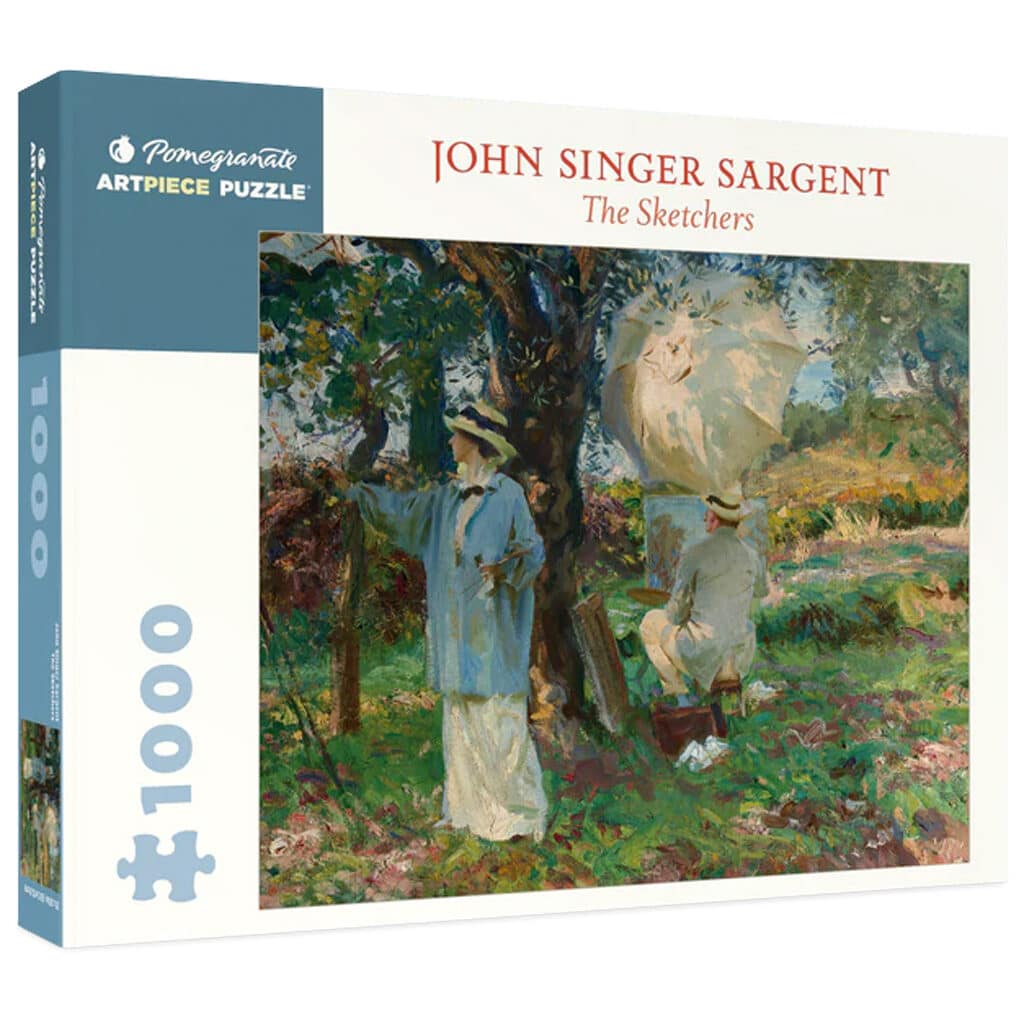
• Puzzle Sargent John Singer

    Sargent John Singer (January 12, 1856 – April 14, 1925) was the most successful portrait painter of his era, as well as a talented landscape and watercolor artist. Sargent was born in Florence to American parents.

    Sargent studied in Italy and Germany, and later in Paris under Emile Auguste Carolus-Duran. He described himself as

    “an American born in Italy, educated in France, who looks like a German, speaks like an Englishman, and paints like a Spaniard.”

    In 1866 he met Violet Paget, the writer Vernon Lee, a contemporary of John and the daughter of English expatriates who were also curious and tireless travelers of the old continent. With her, a companion of his youth in Italy and of his early reflections on art, literature, and music, he developed a bond of affectionate complicity and sincere esteem that would always accompany them.

  • Study in Italy and France

    After a long stay in Germany, he returned to Florence where, in October, he enrolled at the Academy of Fine Arts. After a few months, however, he decided to continue and deepen his training in Paris, now the undisputed capital of modern art and an essential springboard for anyone wishing to pursue an artistic career, moving there in May 1874.

    He enrolled in Carolus-Duran’s studio while simultaneously preparing for the entrance exam at the École des Beaux-Arts, a choice to compensate, with a more rigorous study of academic drawing, for Duran’s tendency toward pure pictorialism.

    During his years of training in Paris, he met several American artists who later remembered him as a young man of undeniable talent, capable even of surpassing his master Duran.

  • Artistic Training of Sargent

    In 1876 he met Claude Monet with whom he became friends.
    The year 1879 was important for Sargent’s artistic training, as he undertook many study trips, showing interest in the art of past masters. In winter, he was in Spain studying Velazquez, whom he had loved since his time at Duran’s studio.

    Aware of the artistic environment around him in the capital of modern art, in 1884 he purchased two sketches by Eduard Manet at an auction held at Drouot, then went to London and, with the novelist and friend Henry James, visited the studios of several artists, including J.E. Millais and Frederic Leighton.

    Portrait of Madame X

    In 1884 he exhibited at the Salon the famous portrait of Madame X, a beautiful and wealthy woman of Parisian high society at the time. The portrait, originally titled with the sitter’s real name, caused a deep scandal, both for the daring depiction of the pearly skin and the provocative attire, with a strap carelessly lowered, forcing the artist first to alter its appearance and then to permanently leave the Parisian market.

  • Plein Air Painting

    At the end of the summer of 1885, due to a minor accident while swimming, he was forced to stay for a period in Worcestershire, England. This began a period of fervent creativity and reflection on French plein air painting.

    This cycle of paintings, dedicated to the history of religion, from paganism to Judaism to the birth of Christianity, was the first of three major public commissions that collectively occupied him for more than three decades, continuing until his death in 1925.

    Between 1916 and 1918 he was in Boston, where he received the commission for the decoration of the rotunda of the Museum of Fine Arts.
    During this American stay, after about a decade, he agreed to again portray two important figures: in 1917 he painted the portraits of oil magnate John D. Rockefeller and Red Cross president Woodrow Wilson.

    But his focus was entirely on major official commissions, the Widener Memorial Library at Harvard University, and the pictorial commemorations of the Great War.

    In March 1925, he completed the Boston mural cycle. On the morning of April 15, after a farewell dinner with some old and close friends organized by his sister Emily in London, he was found dead in his bed.

  • Immagine correlata
  • Immagine correlata
  • Immagine correlata