

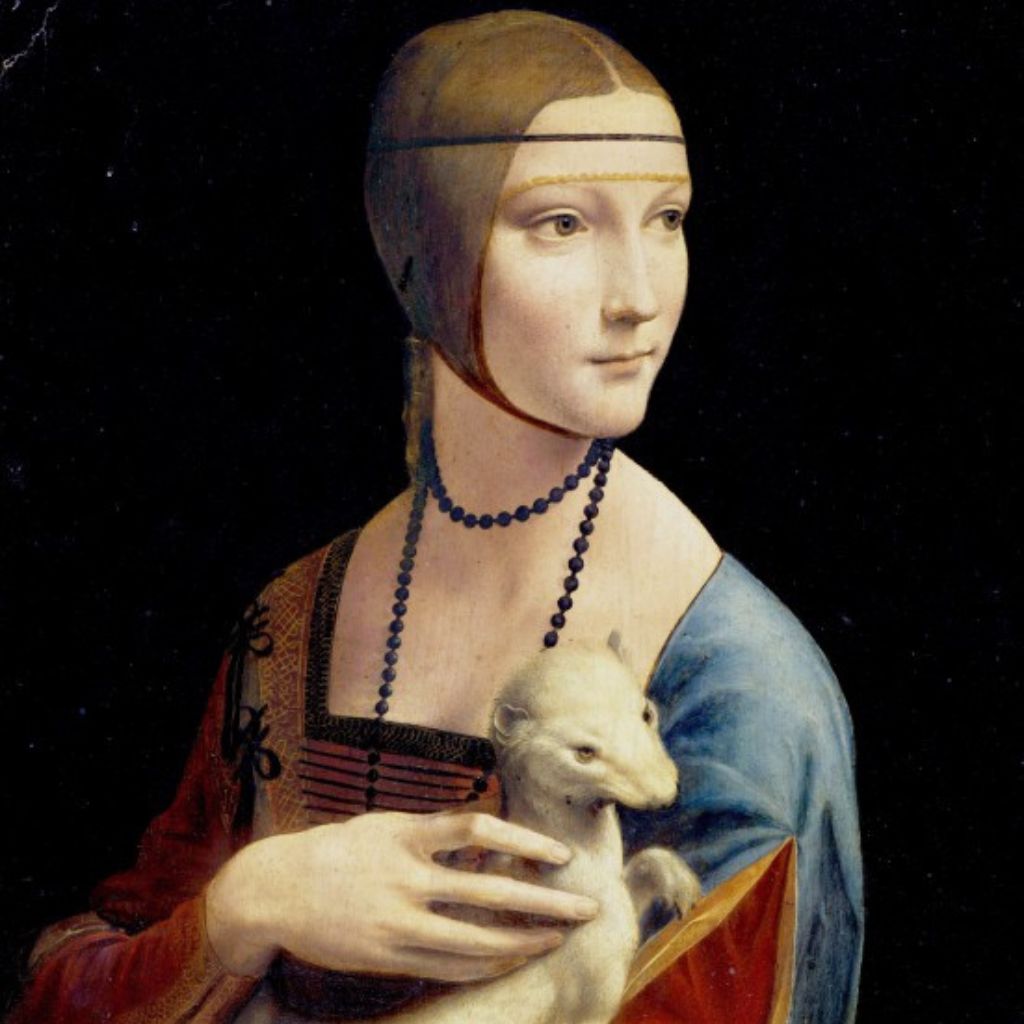
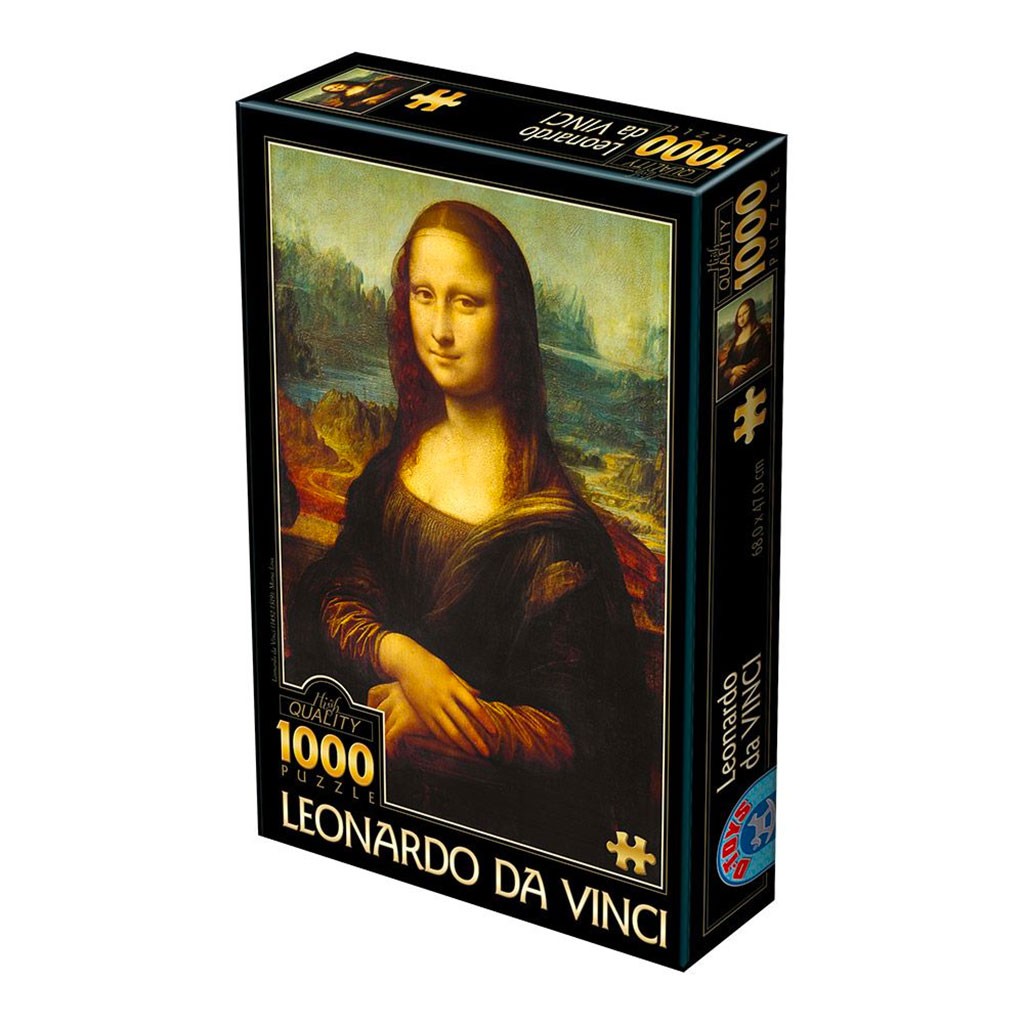
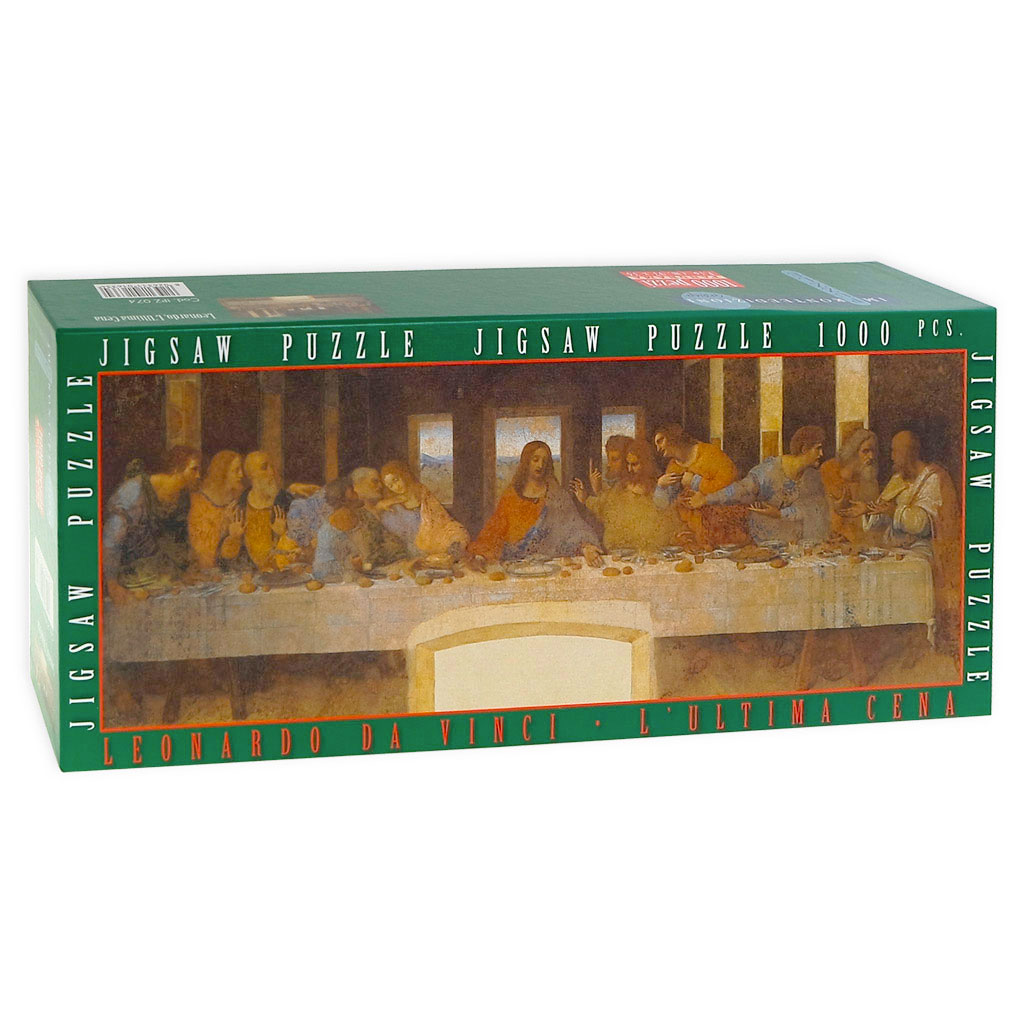
Discover with us our Leonardo da Vinci puzzles and immerse yourself piece by piece in Renaissance art puzzles.
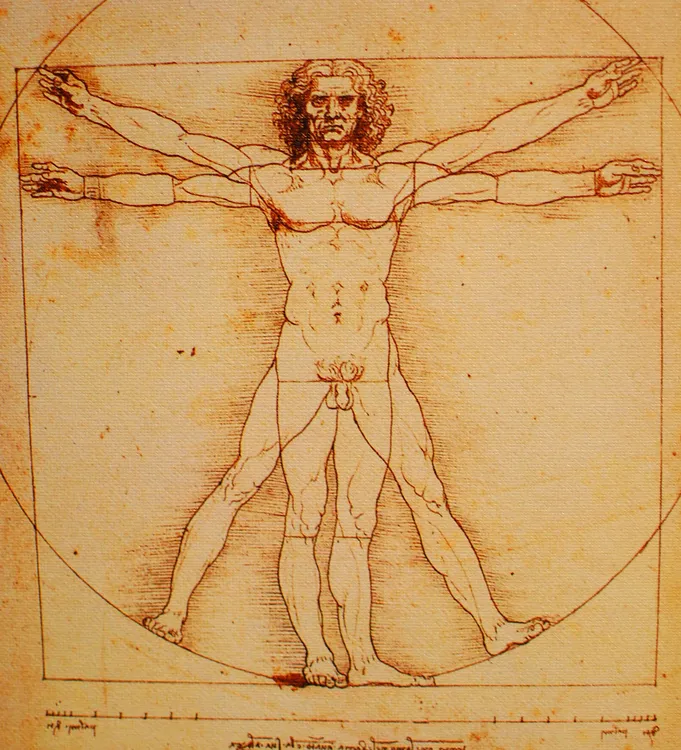
Leonardo’s art is characterized by the great rediscovery of man, of his intellect and of science as a tool of discovery. A connection between humanity and the study of the world.
In fact what strikes us in Leonardo’s paintings is the continuous search for the secrets hidden in nature.
His works are imbued with a profound scientific research and the surgical care of detail is the expression of this attitude.
Observing his works in every detail and discovering them piece by piece means embarking on a journey into an eclectic and wonderful world.
A genius mind to discover with every small piece
The first phase of the activity of Leonardo da Vinci is defined by the period spent studying in the great workshop of Verrocchio. Some Madonnas created with great skill by Leonardo belong to this extremely important first phase of artistic experimentation, in which the light source is double, frontal and from the background.
Leonardo tends, following the taste of the time, to obtain the effect of relief and for this purpose accentuates the curvilinear movement of the contours.
However the opposite incidences of the light prevent the chiaroscuro from turning in a single direction and therefore from sculpturally detaching the figures from the background; in fact this light spreads over the forms with an initial effect of sfumato.
For example The Madonna of the Carnation is very close to the bust of the lady with the bouquet by Verrocchio: the hand forward; the light striking the chest vibrates in the wrinkled fabric at the neckline and reflects trembling on the face. The serene face among the curly hair where the light gets caught and plays; the contours deliberately uncertain so that the figure appears immersed in an atmospheric medium that is weightless but not lacking in density and movement.
More than once Florentine painters had tried to give painted form the solidity of sculpted form: on the contrary sculpture interests the young Leonardo because it does not have defined contours and because it is a body immersed in natural light and atmosphere.
In fact it is clear that Leonardo wants to control the correctness of the relationship between source and screen, and regulate the continuous and natural transmission of light.
For this reason he pays extreme attention to the study of landscape. The way of representing distant scenes characterizes Leonardo’s research: pervaded by a dense and vibrant light, the study of landscape is clearly explained by a pen drawing dated 1473 representing a stretch of the Arno valley.
The line does not outline the contours of things but forms a dense fabric of horizontal, oblique and, in some parts (trees), semicircular hatching, like a halo.
Here the painter wants to imprint in things a dense atmosphere that fills space and that things illuminate with their reflections or darken with their shadows. It is already important that Leonardo observed how the atmosphere is not perfectly transparent and has a density and a color.
Botticelli started from the image or the habitual notion of things, and refined it, spiritualized it, sublimated it until the thing was consumed and the idea was reached;
Leonardo excludes the notion precisely because it still carries an a priori idea, and starts from the pure phenomenon, from what is seen with the eyes before knowing that they are trees, rivers or rocks.
In the fifteenth century Brunelleschi and Piero della Francesca had succeeded, with linear perspective, in breaking through the painted surface, that is to give the impression of the third dimension. Perspective has without doubt been the greatest pictorial revolution in history.
Imagine the first film by the Lumière brothers, imagine the first time color appeared on television, imagine the joy of the first man on the moon.
All this is nothing compared to the mystical experience that the first people must have felt when facing perspectival space.
Thanks to the Italian Renaissance the entire space could now be faithfully described on a sheet of paper.
In the sixteenth century with Leonardo’s research the first tonal perspective, that is aerial perspective, was achieved.
The result was surprising; this principle allowed painters of the time to achieve perfection in the representation of subjects.
An example of aerial perspective is this: to a painter painting a landscape, a mountain appears before any other detail; it has a gray-blue tone when it is far away, a lighter tone where it is higher; moreover it changes in the various tones of blue with the changing light of the day.
This happens because between the eye and the object to be painted there is the atmosphere: the farther the object is from the eye, the thicker the mass of air that will prevent seeing the colors of the objects:
and as many are the varieties of distances in which colors are lost, as many are the varieties of the day, and as many are the varieties of the thickness or thinness of the air through which the species of the colors of the aforesaid objects reach the eye
Because of the thick air that lies between the eye and the objects, the contours of the objects become less and less defined as they move away from sight, while the form appears somewhat vague, as if fading into shadow.
This is Leonardo’s famous invention called sfumato: the painter will make the contours evanescent through glazes of color, making one form indefinite and blending into another
Anyone who has tried to draw a face knows that what we call expression hides above all in two features: the corners of the mouth and the corners of the eyes.
Now it is precisely these parts that Leonardo deliberately left undefined, immersing them in a soft shadow. This is why we are never certain of the mood with which Monna Lisa (La Gioconda ) looks at us. In fact her expression always seems to escape us.
From 1503 is the famous portrait of Monna Lisa del Giocondo, called the Mona Lisa.
It is an oil painting on a poplar wood panel preserved in the Louvre Museum in Paris.
The Mona Lisa is an iconic and enigmatic work of world painting; it is certainly the most famous portrait in history as well as one of the most well-known works of art ever.
The imperceptible smile of the subject, with its aura of mystery, has inspired countless pages of criticism, literature, works of imagination and even psychoanalytic studies; elusive, ironic and sensual, the Monna Lisa has at times been loved and idolized but also mocked or attacked.
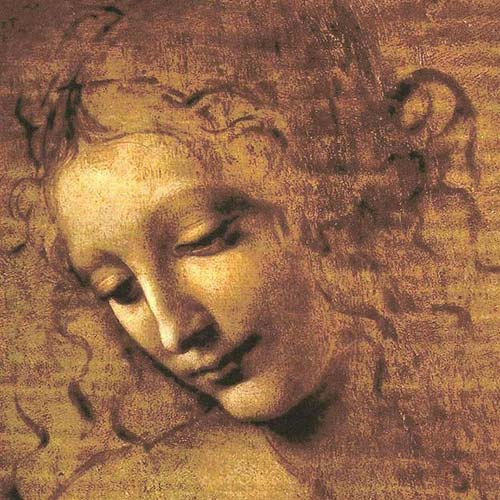
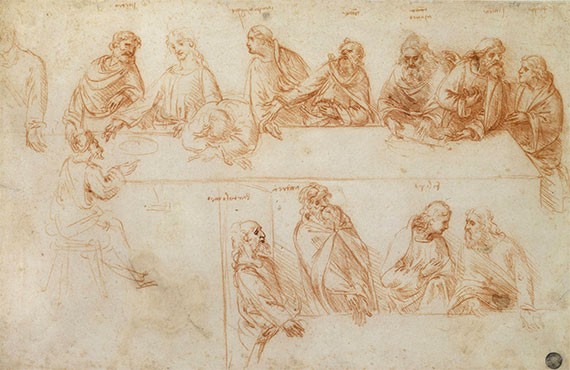
Leonardo was truly the unsurpassed master of drawing and preferred to use the pen and more rarely red chalk and black pencil. Through drawings he affirmed his genius and documented the interests he had in every field of human activity: from painting to sculpture, architecture, mechanics, hydraulics, military art, botany, zoology, anatomy.
He was able to interpret the beauty of nature and investigate the life of men, animals and plants; his drawing, made of moving lines and skillful chiaroscuro, is an expressive means of a state of mind and the character of an object, even a humble one.
Leonardo did not like the fresco technique, whose speed of execution, due to the necessity of applying colors before the plaster dries and traps them, was certainly not compatible with his method, made of continuous reconsiderations, additions and small modifications.
He therefore chose to paint on the wall as he painted on panel. In fact recent restorations have confirmed that the artist worked on the painting using a technique typical of panel painting.