

The art of Edgar Degas is characterized by the magnificent meeting between the artistic innovations of the late nineteenth century and the strength of tradition and academic study. In fact Degas in his iconic ballerinas manages to fully understand the impressionist impulses while maintaining the immense design study of the work typical of painters from Renaissance art.
We have chosen Degas puzzles as an example of beauty and elegance. A continuous meeting between tradition and artistic development.
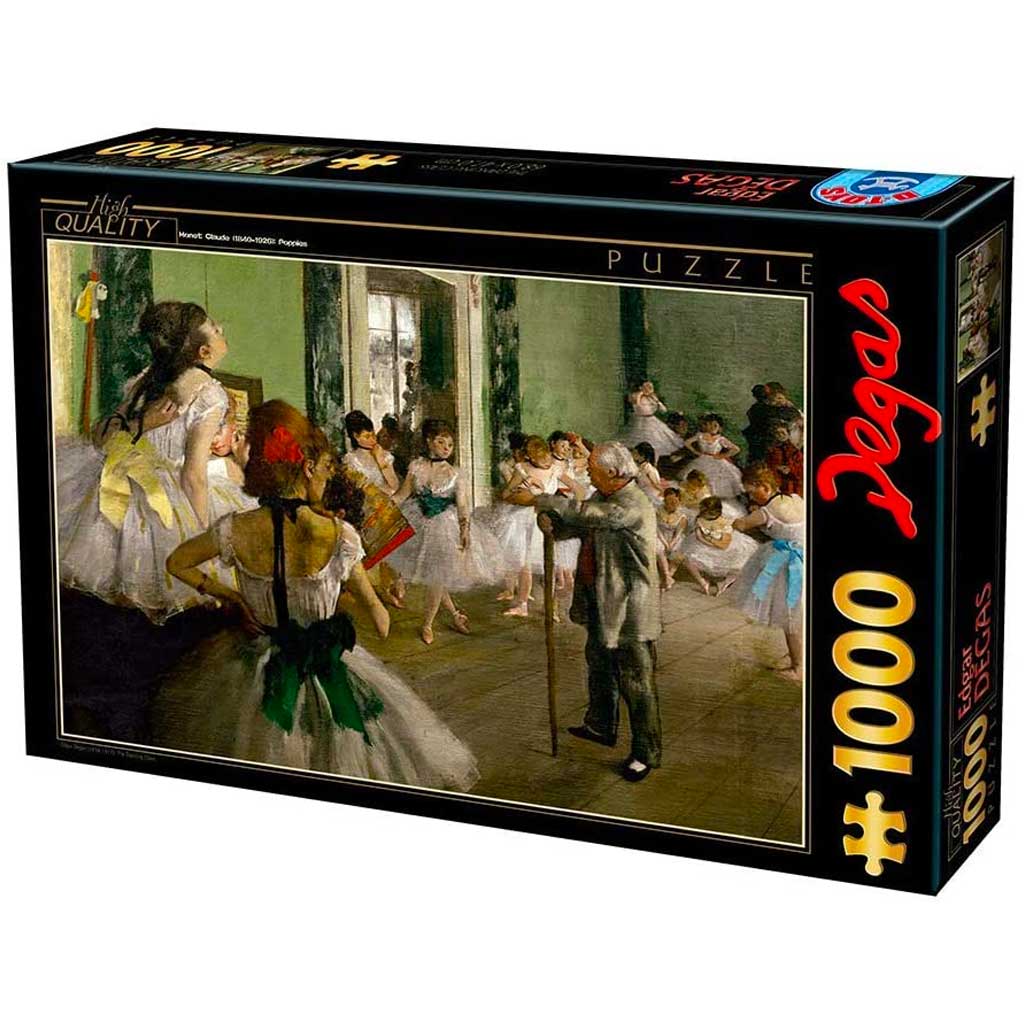
Edgar-Hilaire-Germain de Gas (known as Degas) was born on July 19, 1834 into a wealthy and noble family within which he spent a calm and comfortable childhood and early youth.
His father, a banker of Neapolitan origin, is a man of refined culture and under his guidance the young Degas began very early to frequent the Louvre Museum, where he especially admired the great masters of the Italian Renaissance. The choice to undertake an artistic career was therefore immediately supported by his father.
His first pictorial training took place in an academic environment and his main point of reference was initially Ingres, whose extraordinary purity of drawing he admired above all.
The School of Fine Arts was not for him and after only six months he abandoned attendance and undertook long and regular stays in Italy
from 1854-1859, repeatedly visiting its museums and filling his notebooks with sketches and notes.
From these premises it is immediately clear how Degas’ artistic personality was articulated and complex. Despite his impressionist commitment, for example, he always remained a convinced supporter of drawing and painting in the studio.
According to the artist, in fact, even the impression of a moment is so complex and rich in meaning that the immediacy of painting en plein air can only capture it in a reductive and superficial way.
It is very good to copy what one sees, but it is far preferable to draw what one no longer sees, except in memory; it is a transformation in which imagination collaborates with memory, and thus one reproduces only what struck you, that is, the essential.
In 1861 the artist met Manet, with whom he would maintain for the rest of his life a deep though sometimes conflicted friendship. With Manet he shared a passion for Japanese prints, of which he soon became one of the greatest collectors in Paris, and thanks to him he was also introduced to the group of the Café Guerbois.
In the mid-1860s his painting, while always remaining faithful to the ideals of drawing and studio work, increasingly took on a realistic character. This does not mean representing things and people exactly as they appear, but rather as we know them from having seen them many times and in different contexts, in order to “bewitch reality”, as he liked to repeat, “with the awareness that the artist can succeed in giving the sense of truth only by acting in a completely unnatural way”.
Therefore Degas’ nature is never that which immediately derives from visual sensation, as in Monet, but the complex result of studies, reflections and successive adjustments.
The decade between 1880 and 1893, on the contrary, marked the period of the artist’s greatest fame. In fact, although he had participated in seven of the eight impressionist exhibitions and continued to be one of their most active organizers, he persisted in defining himself as a “realist” rather than an “impressionist”.
The last years of Degas’ life were extremely sad. Now almost blind, he was also evicted from his studio-museum and only thanks to the interest of some friends was he able to find a new accommodation.
To anyone who dared ask him what he was doing he replied acidly:
Painting no longer interests me
He died in solitude on September 27, 1917 and only about thirty people attended his modest funeral. Of the old friends from earlier times only Monet was present, unsteady and almost blind himself.
At this point the great season of Impressionism can be considered definitively concluded.
The activity of Degas as a draftsman is fruitful and vast. In open contrast with the impressionist approach, in fact, he devoted time and passion above all to drawings and preparatory sketches.
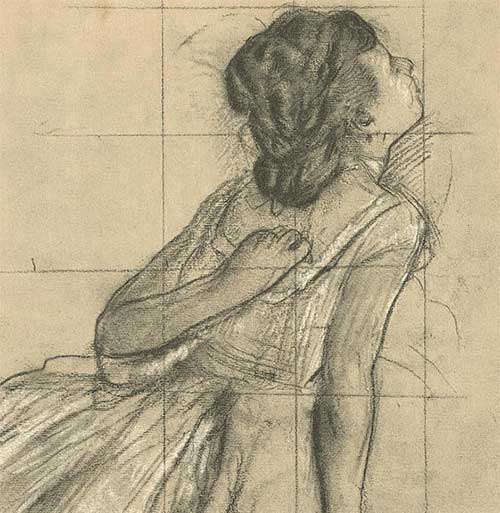
For example, Nude of a Woman Seated Facing Forward, in which the presence of the grid immediately suggests a study for a painting. The young model is seated with her right leg folded on the ground and the left raised vertically. In this way the knee becomes the support for the left arm which holds a head with an intent and thoughtful expression.
The right hand resting on the ground and the arm consequently stretched downward, finally, generate the raising of the shoulder and a slight sinking of the torso, two elements that certainly refer to observation from life.
The precision and confidence of the line, as well as the soft shading of the chiaroscuro, make the sketch an already perfectly autonomous and complete work, free from academic conventions (the pose is certainly not classical), but at the same time also free from any erotic complacency.
Edgar Degas is a painter who does not love landscapes nor, consequently, their representation. His settings, on the contrary, always refer to the characteristic Parisian interiors.
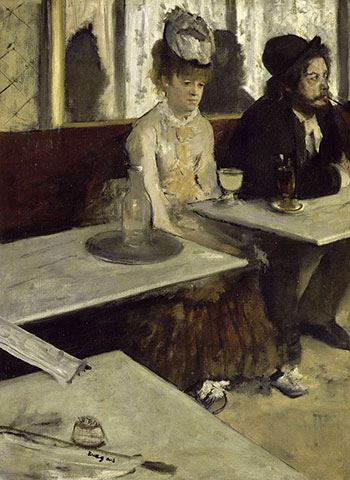
An emblematic example is L’Absinthe, perhaps the most famous of Degas’ paintings.
The work, created between 1875 and 1876, is set inside the Café Nouvelle-Athènes in Place Pigalle which was one of the favorite meeting places of the Impressionists.
The composition (but in this case it would be more correct to call it framing, given the analogy with a photographic shot) is deliberately unbalanced to the right, almost giving the sense of a sudden and casual vision.
The two characters (in reality the professional model Ellen Andrée and the painter and intellectual friend Marcellin Desboutin) play the role of two poor people: a suburban prostitute, dressed in a pathetically flashy way, and a clochard (the typical Parisian tramp) with a rough and unkempt appearance.
In front of the woman, on the marble surface of the small table, there is the greenish glass of absinthe that gives the painting its title. In front of the tramp instead there is a glass of wine. Both characters stare into the void, as if they were following the invisible thread of their thoughts. Although seated next to each other they are extremely distant, almost symbolizing how loneliness can make us strangers and unable to communicate.
The atmosphere of the café is heavy like the state of mind of the two customers, trapped in a squalid and narrow space of which the artist offers a mercilessly realistic description.
The environment of Parisian cafés, moreover, exerted great fascination on all the Impressionists. Manet also tackled the theme several times and with The Plum, a canvas of 1878, seems indirectly to respond to Degas’ Absinthe.
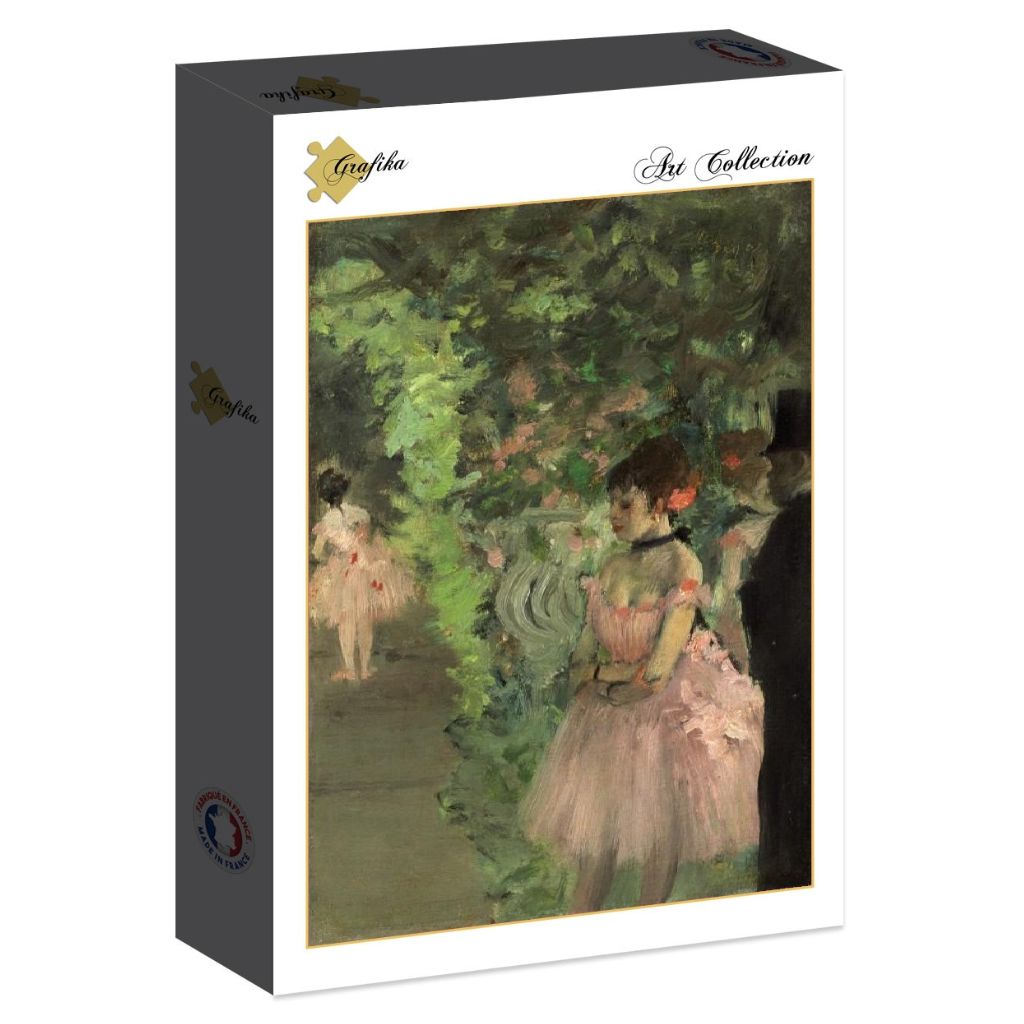
Four Dancers in Blue, also known as Four Dancers Backstage, from 1898, is one of the countless pastels that Degas created in the last part of his career, when painting seemed no longer to interest him.
Their logic is the same according to which Monet produced his various replicas of the Rouen Cathedral. The most recurring subjects are inspired by the intimacy of ballerinas and, more generally, by scenes of female toilette. Each pastel, in this way, constitutes a frame of the ideal film of life, a comparison that is not at all far-fetched since in those same years Muybridge was carrying out the first experiments with sequential photography.
Degas himself took, especially between 1895 and 1899, numerous photographs of ballerinas which he would later use to create drawings and pastels.
The perspective cut of the scene is extremely unconventional, since the point of view is very high, as if the artist were leaning from a theater box. Once the eye becomes accustomed to the scene, however, we realize we are facing a masterpiece of grace and balance. The soft yet confident profiles of the young dancers, in fact, are composed along the two geometric diagonals of the sheet, with a rigor that is anything but casual, further emphasized by the bright blues of the stage costumes.
The plasticity of the female bodies is then rendered through a skillful crossing of hatchings, whose overlapping suggests with great realism the sense of volume. A new and living volume, which makes us perceive the illusion of movement. Baudelaire wrote about him:
He loved the human body as a material harmony, like a beautiful architecture with movement added