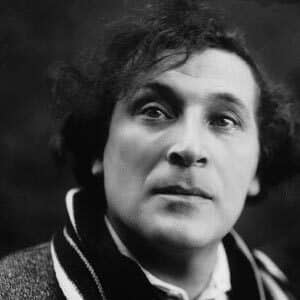


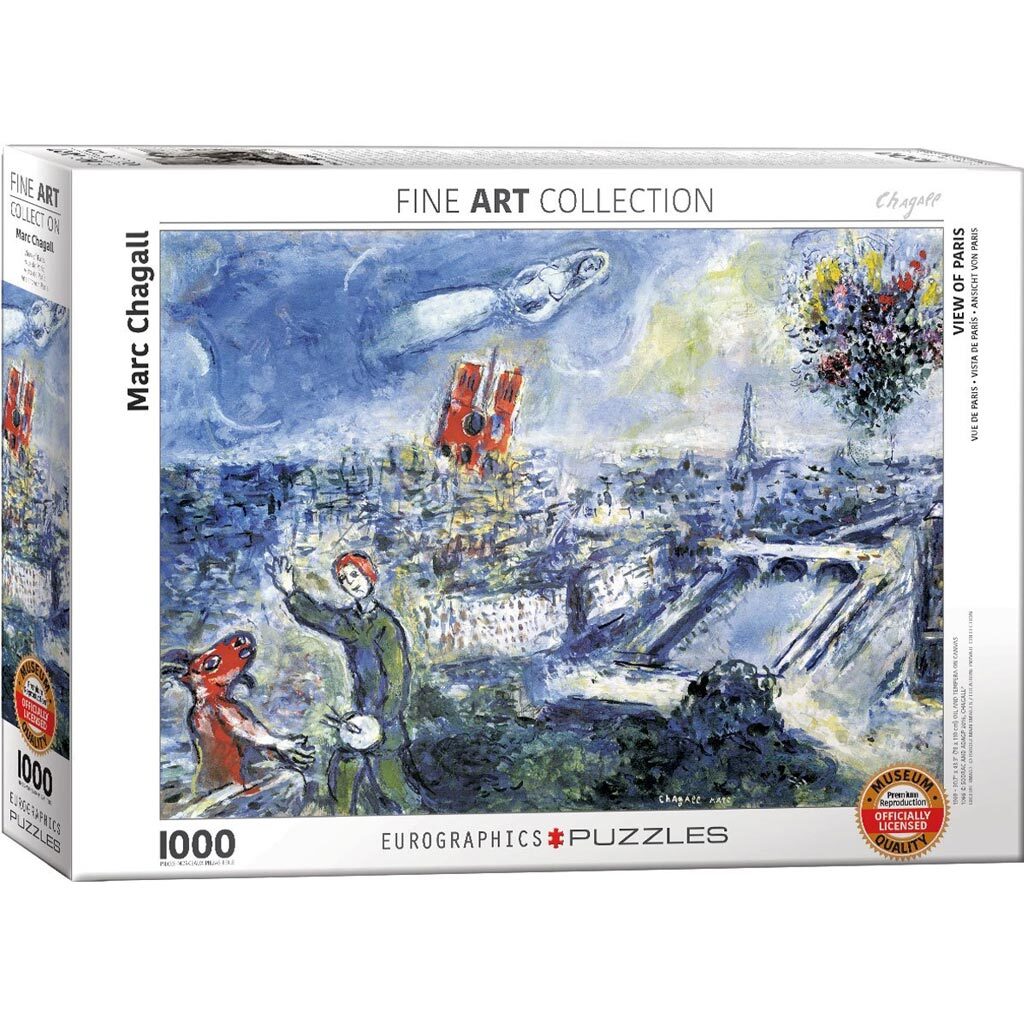
Marc Chagall was born in Liosno on July 7, 1887, in the city of Vitebsk in Belarus. His family was devoutly Jewish.
His father worked in a herring warehouse, and his mother ran a shop selling fish, flour, sugar, and spices.
From 1906 to 1909, he studied painting, first in Vitebsk, then at the School of the Imperial Society for the Promotion of the Fine Arts in St. Petersburg, where he was also a student of Léon Bakst.
In 1910, he moved to Paris, where he became acquainted with the new artistic currents of the time, particularly Fauvism and Cubism.
Chagall spent a lot of time visiting galleries and salons, but especially the Louvre; Rembrandt, Renoir, Pissarro, Matisse, Courbet, Millet, Manet, Monet and Delacroix were the artists he admired most.
In 1909, Chagall met Bella Rosenfeld, the beautiful and educated daughter of a local jeweler in St. Petersburg.
Bella was only 14 years old and attending art school; she was too young for a serious relationship, and Chagall had no money. They became engaged but waited until 1915 to marry. Their daughter Ida was born the following year.
The key to understanding the painter’s canvases is, in fact, the love of his life: Bella Rosenfeld, the source of inspiration for Marc. She is the flying woman, the lover in blue, the protagonist of many masterpieces painted by Chagall.
Bella died in 1944 at just 49 years old.
The artist fell into a deep depression and stopped painting for months.
Although Chagall remarried in 1952, his second wife, Valentina Brodsky, rarely appeared in his works, and Bella continued in her role as muse.
In the French capital, he mastered the gouache technique, which he applied to painting Belarusian scenes considered as intense and melancholic memories of his homeland. He painted his dreams, motifs, and themes of Jewish culture until dawn, drawing on his memories of Vitebsk and Bella, his beloved.
In Paris, Marc Chagall entered the artist circles, met Ambroise Vollard, who commissioned him first for illustrations of Gogol’s “Dead Souls” and then La Fontaine’s “Fables,” and held a retrospective of his works at the prominent Galerie Barbazanges-Hodeberg.
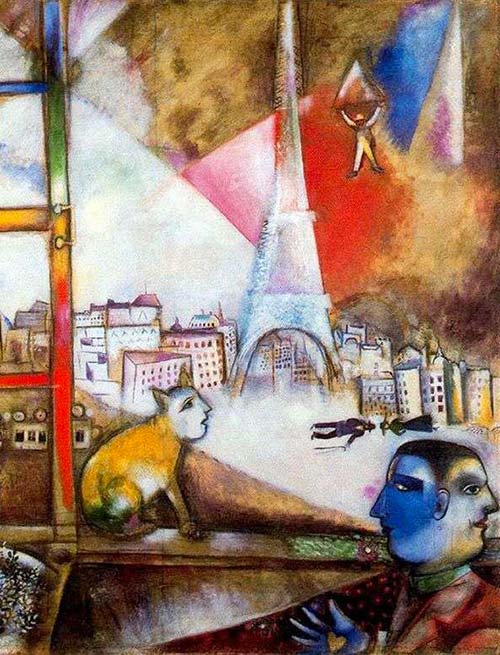
From this Parisian period come the characters dancing in the sky, the bizarre violinist balancing on dollhouse-like buildings, the lovers in blue, his flying scenes over Vitebsk, and his indefinable animals or ghost-like figures drifting in the sky.
A vast sequence of symbols that would later form the foundation inspiring Surrealism.
In 1937, the painter became a French citizen, and during the German occupation, he took refuge with his paintings in the south of France, in the still-free zone, where in 1941 he accepted an invitation from the Museum of Modern Art in New York and traveled to America.
Finally, in July 1941, due to the relentless expansion of anti-Semitism, Chagall and his family took refuge in the United States; he spent most of the early years in New York.
For a time, Chagall continued developing themes he had already explored in France; typical works of this period are the “Yellow Crucifixion” (1943) and “Feathers and Flowers” (1943).
His encounter with music and commissions for the ballets “Aleko” and “The Firebird” concretized his lifelong passion for music.
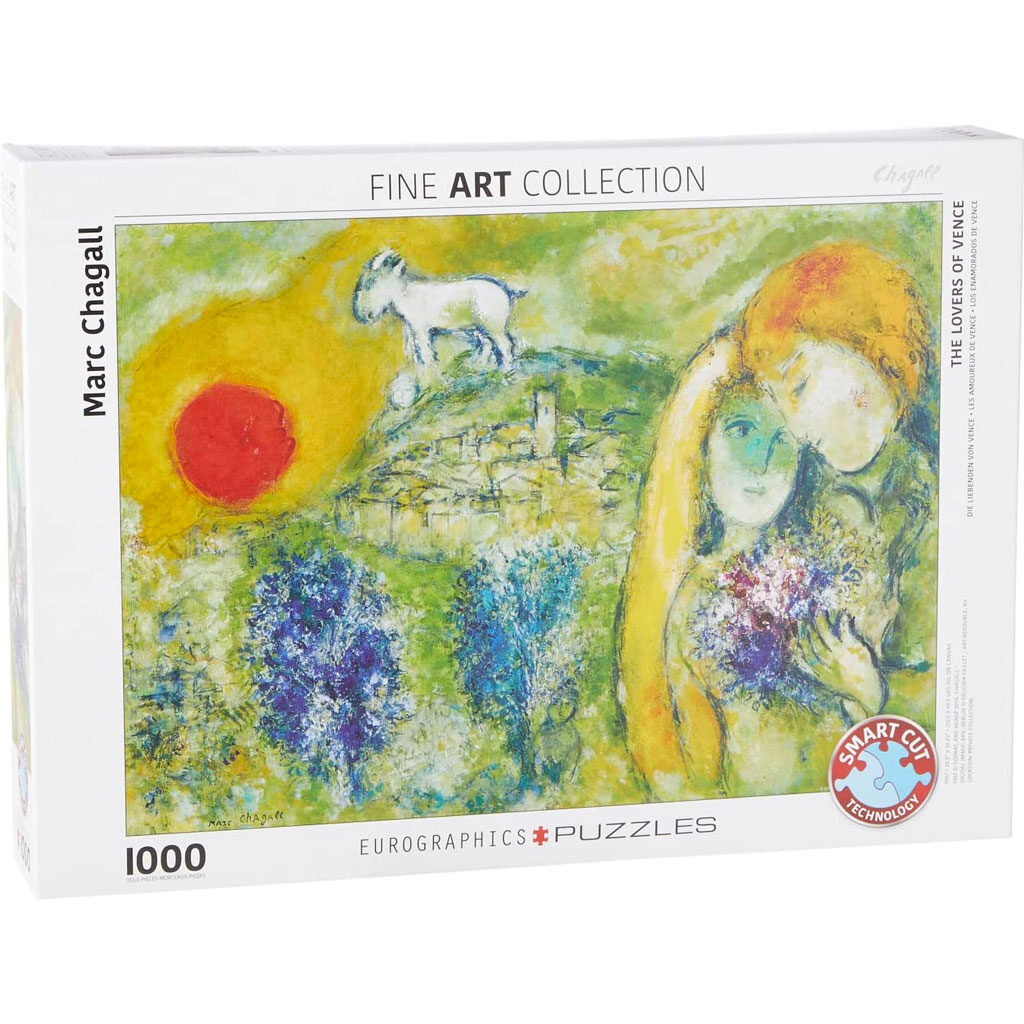
After the war, in 1947, Marc Chagall returned to Paris, and in 1949, settled in Saint-Paul-de-Vence in southern France. Three years later, he remarried.
In the following years, important exhibitions were dedicated to him worldwide, and the painter began a long series of large public works.
The works of Marc Chagall are poems on canvas: vivid colors, dreamlike and surreal subjects, simple and genuine brushwork leave the viewer with a sense of peace and serenity, fostering an immediate empathy with the artist.
Despite Chagall’s difficult life and the harsh blows he suffered, his works, thanks to their bright and energetic colors, convey optimism and happiness.
Among Chagall’s most famous works are Birthday, The Violinist, and The Promenade.
Marc Chagall died in Saint-Paul-de-Vence on March 28, 1985.
Art seems to me to be above all a state of mind. Style is not important. Expression is. In our lives, there is only one color that gives meaning to art and life itself: the color of love. Painting must have psychological content. I suppress every decorative impulse at its birth. I soften the white, blend the blue with a thousand thoughts. The psyche must find its path in the paintings. One must work on the canvas thinking that something of one’s own soul will enter it and give it substance.