

Home / Pompeii Frescoes: Celebrating a New Opening with a Puzzle
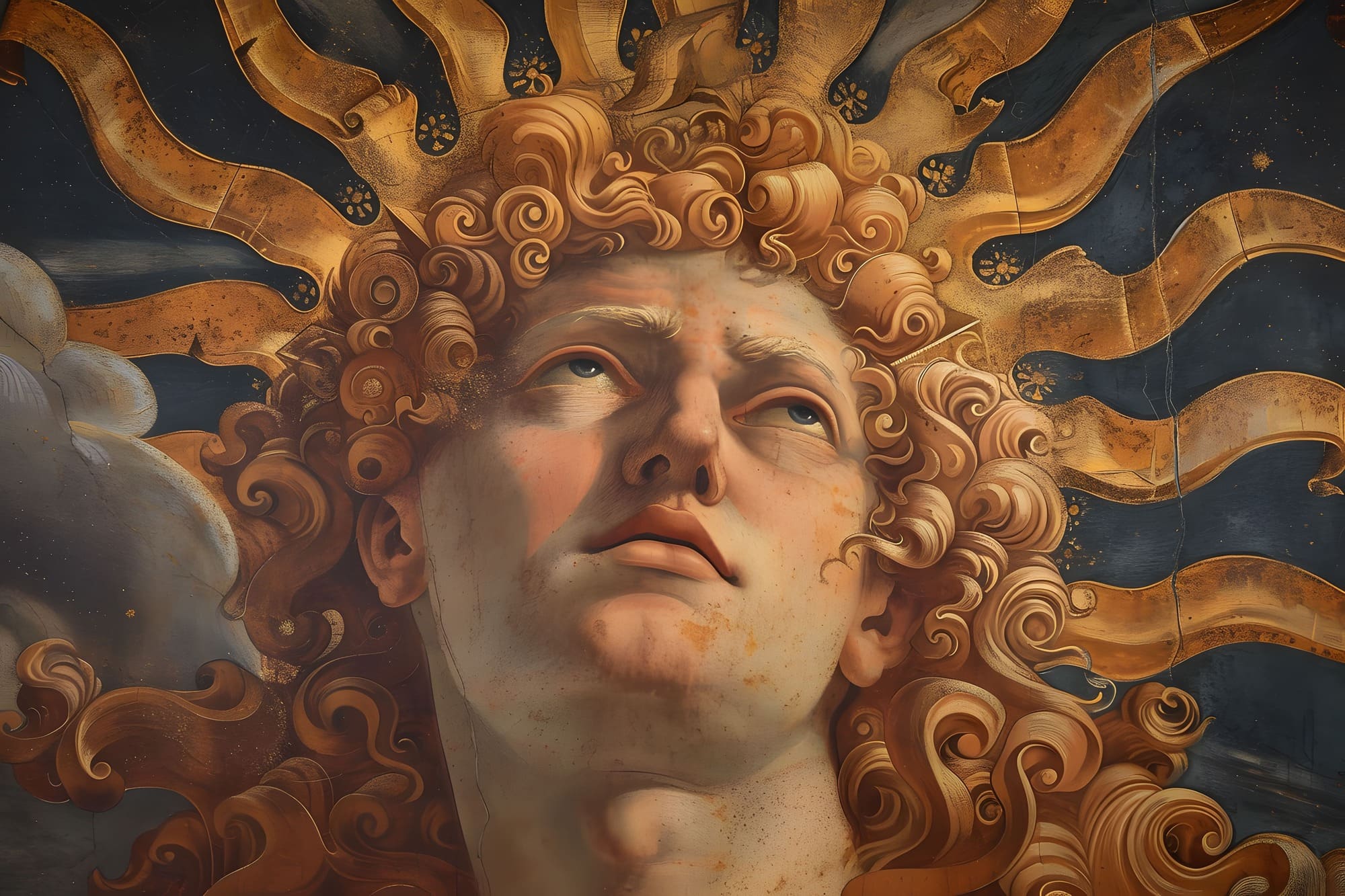
Celebrate the reopening of the “Domus del Frutteto” with us by treating yourself to the “The Offering Girl” puzzle, which depicts one of the most beautiful Pompeian frescoes in the Villa dei Mestieri in Pompeii.
The Pompeian frescoes recount with meticulousness and extreme realism the Roman customs and traditions of around 2000 years ago.
Indeed, they allow us to experience the daily activities of the inhabitants of this vanished city and become passionate about its incredible history. But let’s retrace together the incredible succession of events in Pompeii from its foundation to its disappearance in 79 AD.
Pompeii stands on a volcanic plateau, on the southern slope of Vesuvius , about 30 metres above sea level and a short distance from the mouth of the river Samo, in a suggestive position, already praised in Roman times by Seneca in the 1st century AD.
The population who founded Pompeii was certainly Oscan, but it is uncertain whether the name of the city itself derives from Greek or Oscan.
The city’s fortune was tied from the beginning to its seaside location. However, on August 24, 79, tragedy struck.
At dawn, a large pine-shaped cloud appeared over Vesuvius; at ten o’clock in the morning, gases pressing from within exploded the solidified lava blocking the volcano’s crater, shattering it into countless fragments. Countless lapilli were hurled at Pompeii, along with a rain of ash so thick it obscured the sun. Amid terrible earthquake tremors and poisonous gas fumes, the city ceased to exist that very day, and remained buried for centuries under a blanket of ash. over six meters of ash and lapilli.
August 24, 79 AD was the date of its first historical eruption . It must have previously experienced a long period of dormancy. We have an account of those terrible days in two letters that Pliny the Younger wrote to Tacitus. In them, the author also describes the death of his uncle, Pliny the Elder, suffocated by fumes and eruptive gases on the beach at Stabiae.
A cloud was forming (to those who watched it from so far away it was not clear from which mountain it originated, it was later learned from Vesuvius), whose appearance and shape no tree could have better expressed than a pine. For, stretching upward like a very tall trunk, it then spread out like branches: because, I believe, first lifted at birth by a current of air and then abandoned to itself when that ceased or, yielding to its own weight, it would no longer be able to escape, it spread out lazily. Sometimes white, sometimes dirty and spotted, because of the soil or the ash it carried they had closed their eyes. […] Already the ash was falling on the ships, hotter and denser the closer it got than the pumice and even the blackened pebbles baked and crushed by the fire; then behold an unexpected shoal and the beach blocked by rocks thrown up from the mountain. (Pliny lands at Stabia)[..]It was already day everywhere, but there reigned a night darker and deeper than any other, even though broken by fires and various lights[…]«
Pompeii and Stabiae were buried under a blanket of ash and lapilli, while Herculaneum was submerged by a sea of mud after the eruption. The damage was enormous (it is estimated that around 2,000 people died in Pompeii alone): Emperor Titus established a relief commission and donated the recovered goods to the survivors.
The first attempts to rebuild Pompeii and other centers were swept away by a new eruption in 202 and 472. In 512 Theodoric, king of the Goths, pardoned the taxes of his subjects affected by another eruption. Many others followed until 1139 .
A long period of inactivity followed, during which Vesuvius was repopulated and covered with vegetation right up to the summit. But volcanic activity suddenly resumed on December 16, 1631. All nearby settlements were destroyed, approximately 3,000 people died, and smoke darkened the sky as far as the Gulf of Taranto for several days.
Since then, there have been numerous eruptions, and the last eruption occurred in March 1944. The volcano, still active, is currently in a quiet phase.
The city was almost forgotten, to the point that, when at the end of the 16th century the architect Domenico Fontana, while building a diversion canal for the Sarno, discovered some epigraphs and even buildings with frescoed walls, he did not recognize them as the remains of ancient Pompeii.
The first real excavations in the Pompeii area immediately revealed the magnificence of the Pompeii frescoes and began in 1748 at the behest of King Charles of Bourbon . Unfortunately, it often happened that the buildings gradually brought to light were stripped of objects and works of art and then covered again.
From 1860 , with the advent of the Kingdom of Italy , the work entrusted to the direction of Giuseppe Fiorelli was conducted systematically and with rigorous scientific method. Fiorelli, among other things, intuited the possibility of obtaining casts of the eruption’s victims by pouring liquid plaster into the void left by the bodies, now dissolved, in the solidified ash. These casts, in the Antiquarium of Pompeii, constitute one of the most tragic testimonies of the catastrophe.
Today, Pompeii appears to us in almost its entirety, taking us back to the day when fate halted the course of its history: life seems to have stopped a moment ago. The election slogans on the walls, the household furnishings, the shops, everything still seems alive. The tragedy of Pompeii didn’t destroy the city; it simply stopped time to restore it to us as it appeared on that precise day in 79 AD.
Entering the city you discover the wonderful Pompeian frescoes and its extraordinary works of art.
Near the entrance gate (Porta Marina) a small gate gives access to the so-called Imperial Villa , with a long portico built in front of the walls and dating back to the end of the 1st century BC. The pictorial decoration of the triclinium is very interesting, rather complex, featuring three large painted panels with Theseus defeating the Minotaur, Ariadne abandoned by Theseus and Daedalus and Icarus.
The Antiquarium of Pompeii, founded in 1861 and destroyed by bombing during the Second World War, was reconstructed in 1948 according to modern museographic standards, to offer the most complete picture possible of the city’s history. The entrance features sculptures from Pompeii buildings, while the walls are adorned with Fourth Style paintings from the Portico of the Triclinia.
Turning left onto Via della Fortuna, we soon reach the House of the Faun , one of the most luxurious homes in Pompeii.
Dating back to the Samnite period (when it was a large but modest house), by the late 2nd century BC it had grown to occupy an entire insula (island), reaching enormous dimensions and receiving sumptuous stucco and mosaic decoration. The greeting “HAVE” written in polychrome tiles on the pavement in front of the entrance door still welcomes visitors to this magnificent residence today.
Two hundred meters from the Villa of Diomedes is the Villa of the Mysteries , which houses extraordinary treasures such as the Dionysian Rites painted on the walls against a background of bold Pompeian red . This grandiose building is among the most interesting in Pompeii, due to the harmonious and unique layout of its rooms and the superb pictorial decoration. Built in the first half of the 2nd century BC, it was modified and expanded several times; it now appears as a quadrilateral structure surrounded by panoramic terraces, a hanging garden, and loggias. A magnificent villa that conceals all the secrets of past rites. [/vc_column_text][vc_single_image image=”3288″ img_size=”full” alignment=”center” css=”.vc_custom_1572638259868{margin-top: 30px !important;margin-bottom: 30px !important;}”][vc_column_text]
A major announcement was made a few days ago: the ” House of the Orchard ” has been returned to the public. Visitors to the Pompeii Archaeological Park will now have the opportunity to admire the Domus, which likely belonged to a wealthy winemaker from the Roman city of Pompeii.
The magnificent finds in this domus, dating back to the Flavian period of the early Roman Empire, are remarkable. However, the hypothesis of a winemaking house emerged when, during excavations in 1951, numerous amphorae intended to hold wine were discovered in the house’s garden. Among the household utensils was a large kettle, which the Romans used to heat water to mix with wine. Visitors will be able to observe the Domus’s marvelous frescoes up close while restorers are still at work. The official opening to the public is scheduled for February.
Indeed, thanks to the gardens theme, Pompeii’s offerings this year are entirely “green.” Nature is emphasized not only as a paleobotanical reconstruction of ancient landscapes, but also through the reconstruction of historic gardens.
The Sherwood Forest project.store supports and participates in this beautiful and simple initiative: bringing the Gardens of 2000 years ago to life.