

Home / Louvre Museum, Paris

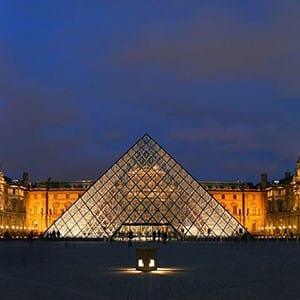
The Louvre Museum Paris in French Musée du Louvre is one of the most famous museums in the world and the first in number of visitors.
It is located on the bank between the Seine and Rue de Rivoli.
It takes its name from the palace that houses it. Originally it was a fortress, built at the end of the 12th century during the reign of King Philip II.
The remains of a large keep around which it is possible to walk during museum visits and which served as a repository for the Royal Treasury and the Archives.
The Palace was the actual seat of the French monarchy until 1682, when Louis XIV moved to the Palace of Versailles.
In fact, with Francis I, in 1515, the Louvre became the main residence of the kings of France. The king replaced the keep with a paved courtyard and had the entire palace renovated by the architect Pierre Lescot.
The palace remained the formal seat of the king until the end of the Ancien Régime in 1789. It was the revolutionary government that fully implemented already initiated projects of transformation into a museum, inaugurating it as such in 1793.
The Louvre collection preserves approximately 300,000 works prior to 1948, of which about 35,000 objects are exhibited.
The immense collection follows a thematic orientation within various areas of the exhibition space: Near Eastern, Egyptian, Greek, Roman and Etruscan antiquities, history of the Louvre, medieval Louvre, painting, sculpture, art objects, graphic art and Islamic art.
The pride of the museum is its collection of 11,900 paintings, which represents the second largest collection of pictorial art in the world. In fact, it is surpassed only by that of the Hermitage Museum in Saint Petersburg.