Additional information

Number of pieces

Brand

Atmosphere

Artist

Opportunity

Artistic movements

art museum

Difficult

Puzzle Dimensions

50.8 x 63.5 cm

Box Dimensions

33 x 25 x 5 cm

EAN

9780764970863

5 motivi per acquistare i nostri puzzle d'arte

Puzzle Ricercati Puzzle Arte

Puzzle d’arte rari e ricercati

Spedizione Gratuita Puzzlearte

Spedizione gratuita sopra i 50€

Consulenza Puzzlearte

Consulenza e assistenza da veri esperti

Progetti Rimboschimento Puzzlearte

Progetti di rimboschimento

Bambini Puzzlearte

Progetti educativi per i più piccoli

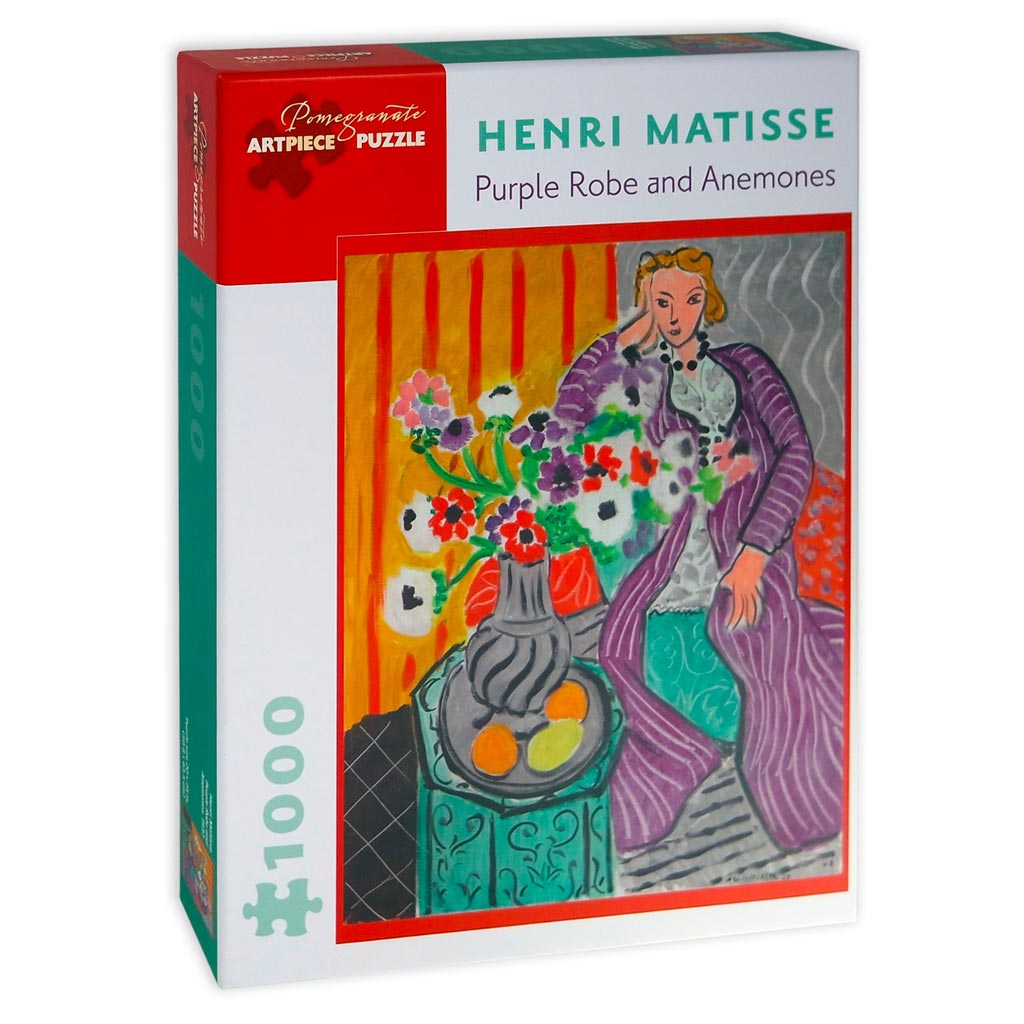
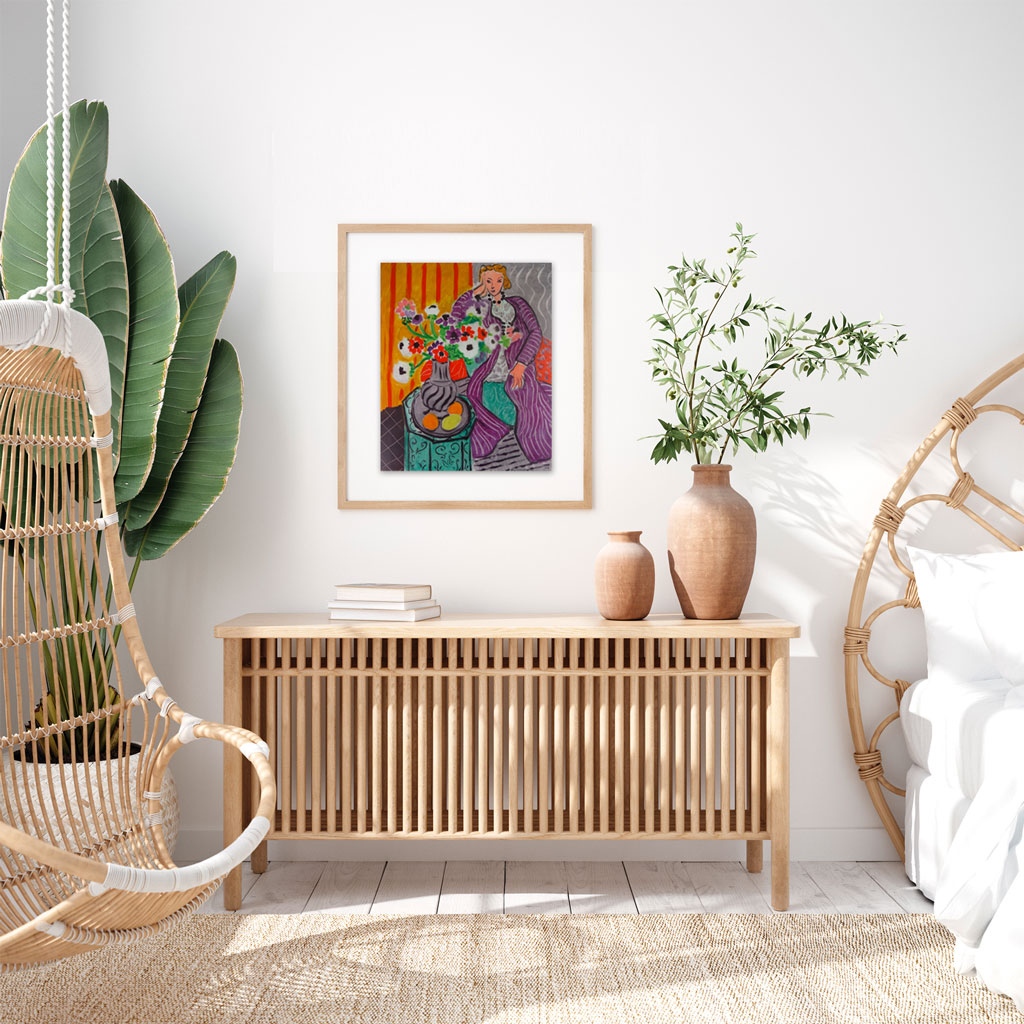
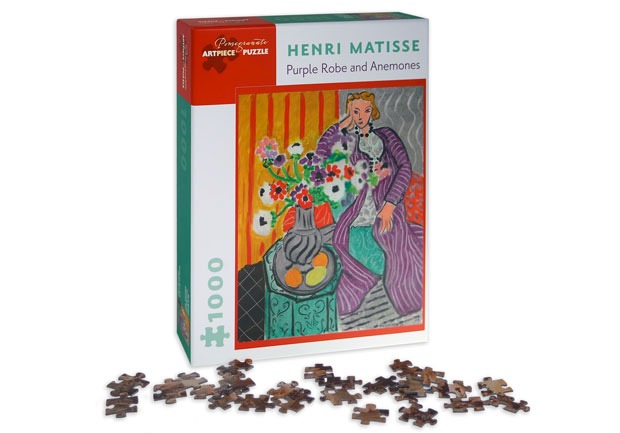
Matisse Purple Robe and Anemones – 1000-piece puzzle

Novità!

21,90

21,90

Out of stock

Discover one of the French master’s most unique and sophisticated masterpieces. The 1000-piece Matisse Purple Robe and Anemones puzzle from Pomegranate lets you relive the expressive lines and colors that characterized the artistic style of Fauvism.

Questo puzzle è momentaneamente esaurito.

Nel frattempo, ti suggeriamo alcuni puzzle d’arte che potrebbero piacerti!

Altri puzzle di Matisse

Henri Matisse
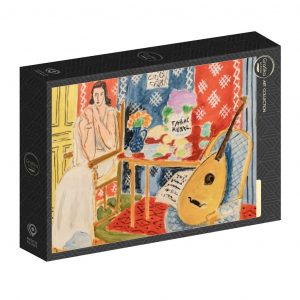
Henri Matisse -Tabac Royal puzzle 500 pcs
25,00
Matise Puzzle
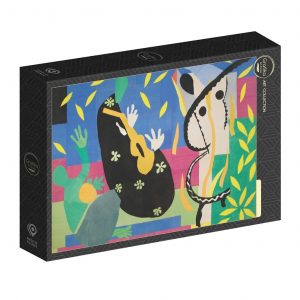
Matisse 500-piece puzzle: The Sadness of the King
25,00
Finestra Aperta Matisse
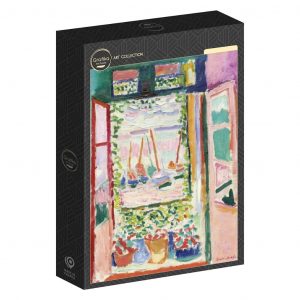
Matisse Open Window – 1000-piece puzzle
29,90

Puzzle Features

The Matisse Purple Robe and Anemones puzzle is a wonderful way to discover the wonders of the expressionist art of the “Fauves”.

Indeed, thanks to this wonderful 1000-piece art puzzle from Pomegranate Communication Inc. , you can rediscover the full force of color typical of Fauvism . The lines are bold, the colors bright, and the subject is intriguing, engaging, and aesthetically captivating.

This puzzle is suitable for both experienced puzzle builders and beginners thanks to its two-dimensionality and clearly identifiable colored areas that make it easy to build.

The Matisse Purple Robe and Anemones Puzzle

The 1000-piece “Matisse Purple Robe and Anemones” puzzle from Pomegranate Communication Inc. is a sought-after example of a modern art puzzle.

The subject is very rare and particular and represents one of the most beautiful and unique works of the Fauvism movement.
The puzzle’s lines are bold, the colors bright , and the details are meticulously crafted. The pieces are sturdy, and the fit is of excellent quality.

Number of Puzzle PiecesNumber of pieces
1000
Puzzle BrandsBrand
Pomegranate
Puzzle DimensionsPuzzle dimensions (cm)
50.8 x 63.5
Puzzle Box DimensionsBox dimensions (cm)
33 x 25 x 4.5

Well finished box
Wonderful gift idea

Famous work of art
Bright colors

1000 pieces
Standard grid

Description of the artwork

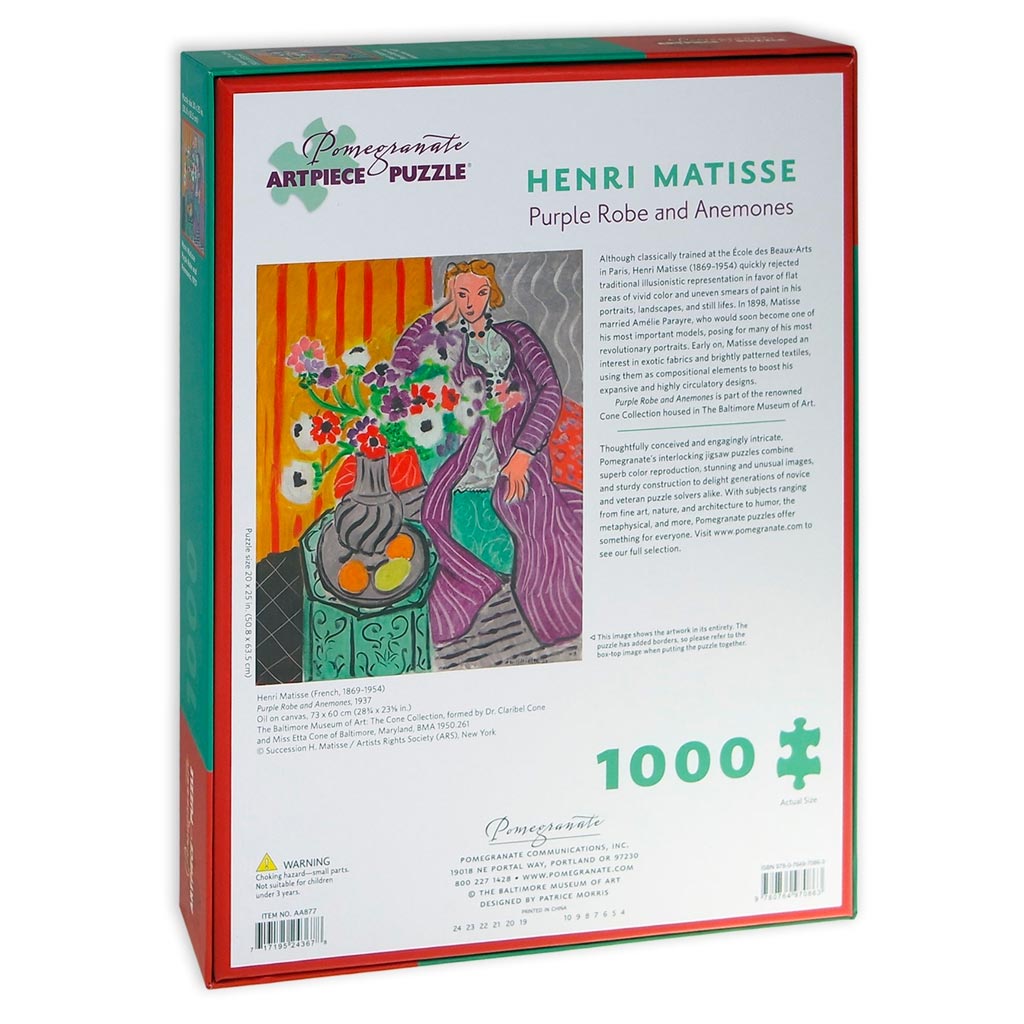
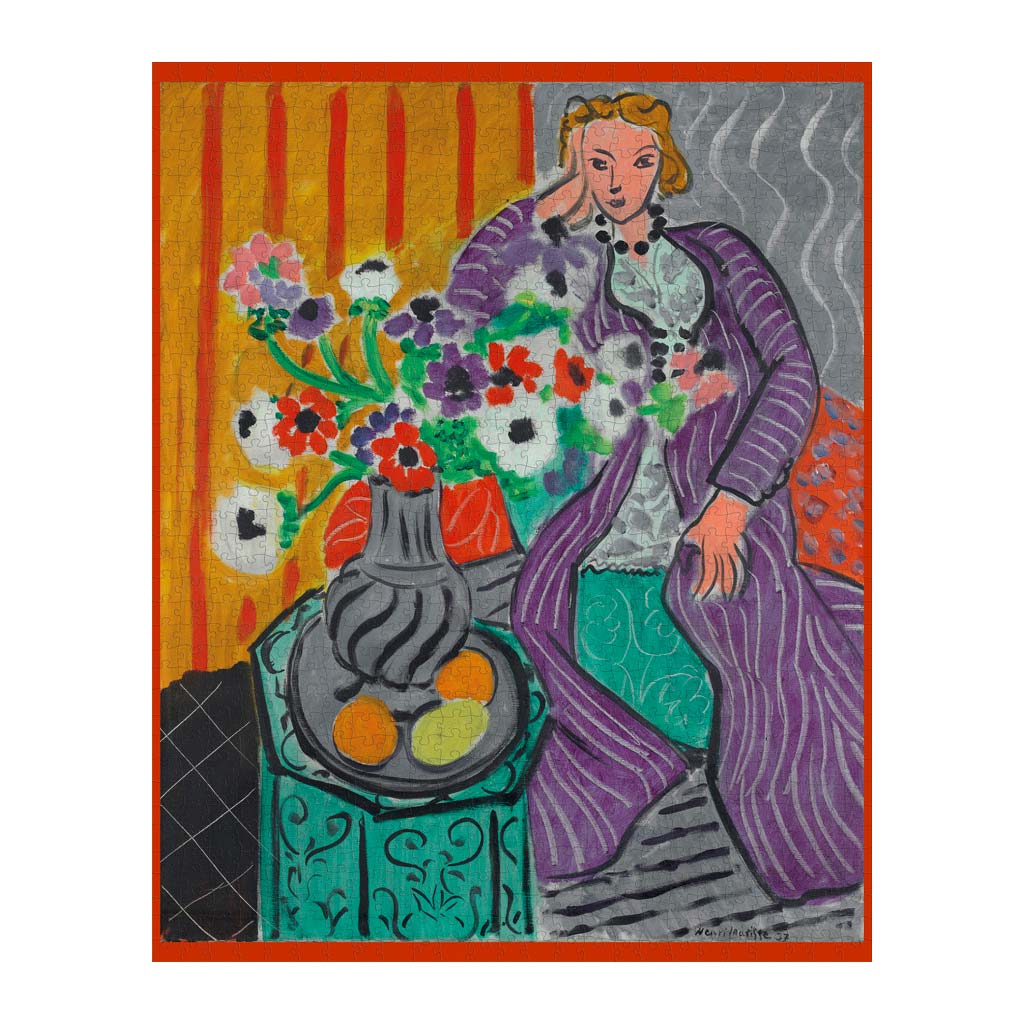
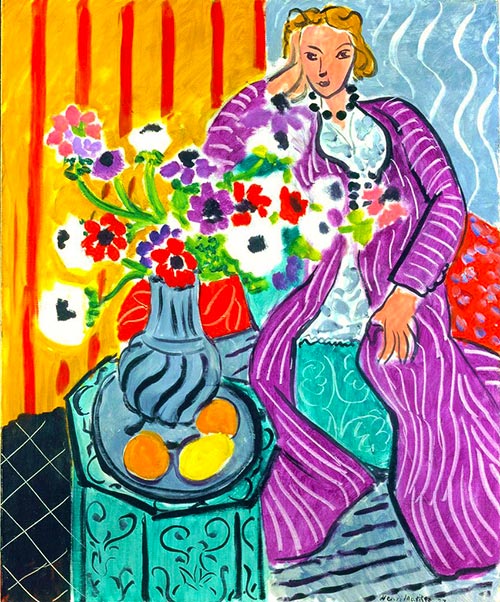
Matisse’s painting Purple Robe and Anemones , created in 1937, depicts a woman, the painter’s assistant Lydia Delectorskaya , wearing a purple coat. Her dress is reminiscent of traditional Moroccan attire, reflecting the painter’s passion for North African culture.

This is one of Matisse’s last oil paintings on canvas . In fact, he soon devoted himself exclusively to collage works.

The painting Woman with a Purple Robe and Anemones is a superb example of the use of color and light to express emotion in life, not towards the model as some artists will, but towards life itself.
Although there isn’t a single clear line, the way the colors juxtapose each other makes for a simple and immediate read.

Matisse and emotions

There is no clear outline on some of the elements, such as the anemones on the table.
Everything else is surrounded by a thick black outline that accentuates all other features, seemingly pushing Lydia and all other objects out.
The vivid purple coat with black outline makes Lydia almost pop out of the chair she’s sitting on, making her the main focal point , as she should be.
This solution makes the composition dynamic and gives it a very strong emotional meaning .
The different patterns of the wallpaper also give the impression that it is in the corner of the room.
The positioning of the flowers to her right and the magazine at her feet also alludes to this sense of depth.

Matisse's portraits

The French master’s entire production of portraits deserves a separate chapter.
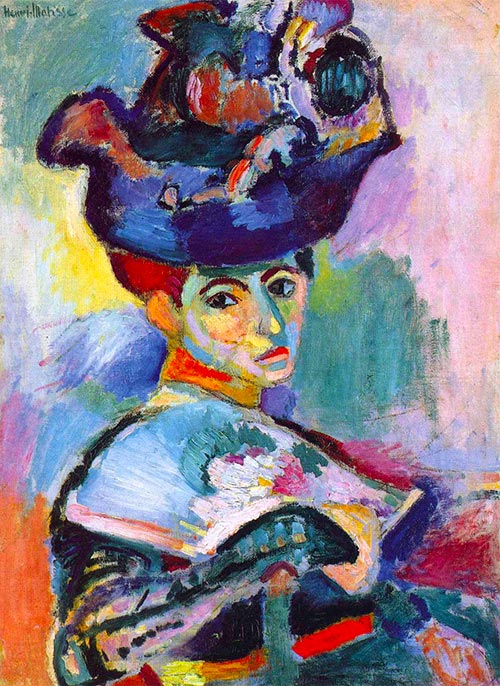
Matisse’s Woman with a Hat was exhibited, along with nine other works by the artist, at the Salon d’Automne in 1905.
The set of colors, barely justified by the form they give life to, seemed to a critic who visited the exhibition “a pot of colors tipped in the face of the public.”
The woman, in three-quarter view, turns her gaze towards the observer, showing herself in her refined and overabundant bourgeois clothing dominated by a sumptuous and monumental hat.
The violence of the colors is the way the artist uses to assert himself and his personality.
Colors are used both pure and in combination with others. In particular, yellows are paired with violet, red with green, and blue with orange, in a mutually reinforcing complementarity. Furthermore, the primary colors themselves are arranged side by side.

The spaces on the canvas

Unlike Van Gogh and Gauguin , for whom the colours they used were an exaltation of those already present in the subject represented, Matisse does not seek objective chromatic similarity.

However, each color has a specific function in shaping the body and creating shadows. Those on the face, for example, are green, while those on the neck are orange.

The paint is distributed forcefully across the canvas, yet with such immediacy that it doesn’t completely cover it. Indeed, large unpainted spaces on the surface emerge here and there, becoming elements of the composition themselves.

Matisse’s simplification

Over time, Matisse ‘s research focused on further simplification of forms, chromatic essentiality, the use of contrasting shades and rhythmic, ornamental lines.

For Matisse, drawing is not an exercise of particular skill, a means of expressing intimate feelings and describing moods. The French master’s works are simplified means of giving greater simplicity and spontaneity to expression , which must reach the viewer’s spirit without heaviness.

Ultimately, painting itself becomes for Matisse a sort of highly expressive drawing, colored in broad and often bright fields. This is the case of Lady in Blue .


Lady in Blue Matisse

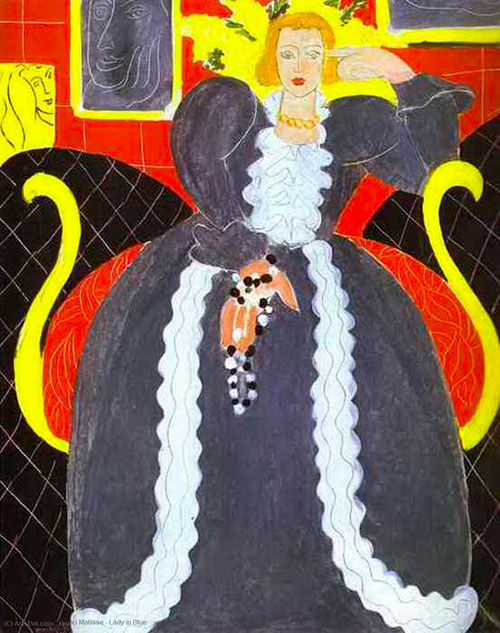
In Matisse’s painting Lady in Blue , the naturalistic color has remained only in the pink of the woman’s skin, while the proportions, understood in the traditional sense, are no longer recognizable in this 1937 painting.

In fact, the artist exaggerated the size of the hands to allow for the manifestation of his own expressive potential.

Underneath the blue dress edged in white, which dominates the canvas, no body can be perceived.
The red armchair the woman sits on has sinuous yellow armrests, while the backrest blends in with the red checkered wall behind it.
The perspective has been modified and the black tiled floor is therefore tilted ninety degrees, curving further to follow the ideal shape of the backrest.

Matisse in Italy

Despite the small size of the canvas, the lady dressed in blue appears monumental and solemn.
Like other contemporary paintings, it seems to retain the memory of the trip to Italy that Matisse made in 1907 and which saw him contemplate the full-bodied figures of Giotto in Padua and the immobile, magical presences of Piero della Francesca in Arezzo.
The possession of such many expressive means and their continuous renewability certainly make Matisse the first truly great artist of the twentieth century .

Reviews

There are no reviews yet.

Be the first to review “Matisse Purple Robe and Anemones – 1000-piece puzzle”

Your email address will not be published. Required fields are marked *

Complimenti!

hai una vera passione per l'arte!

Visto che sei arrivato fino a qui, meriti un premio!
Ecco uno sconto del 10% per il tuo prossimo capolavoro! ✨

Cosa se ne pensi di questi puzzle d'arte simili...

Novità!
Hot Hot

Price range: 19,99€ through 25,00

Select options This product has multiple variants. The options may be chosen on the product page
Hot Hot

25,00