





Additional information

Number of pieces

Brand

Atmosphere

Artist

Opportunity

Difficult

Puzzle Dimensions

68 cm x 48 cm

Box Dimensions

31 cm x 24 cm x 6.5 cm

EAN

8026311022090

5 motivi per acquistare i nostri puzzle d'arte

Puzzle Ricercati Puzzle Arte

Puzzle d’arte rari e ricercati

Spedizione Gratuita Puzzlearte

Spedizione gratuita sopra i 50€

Consulenza Puzzlearte

Consulenza e assistenza da veri esperti

Progetti Rimboschimento Puzzlearte

Progetti di rimboschimento

Bambini Puzzlearte

Progetti educativi per i più piccoli

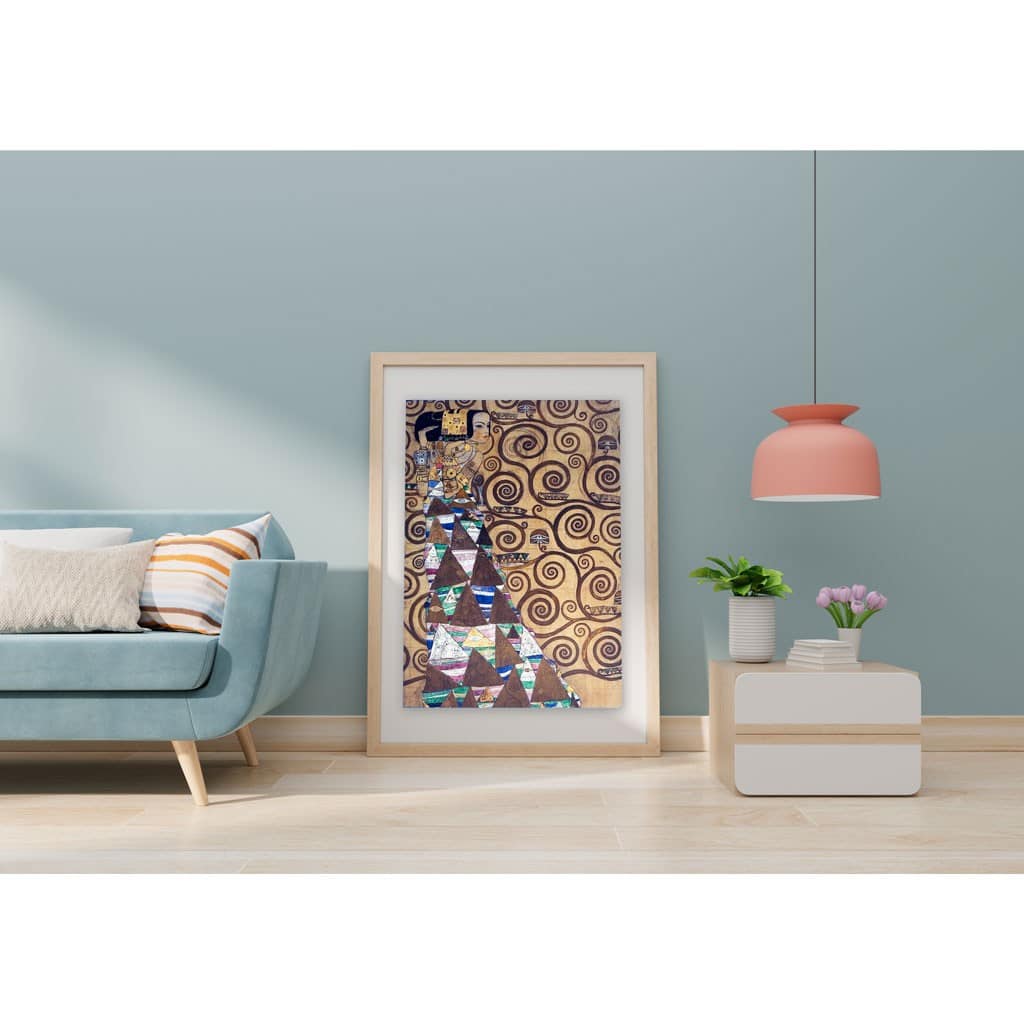
Klimt’s Puzzle: The Wait

(0 customer reviews)

25,00

25,00

5 in stock

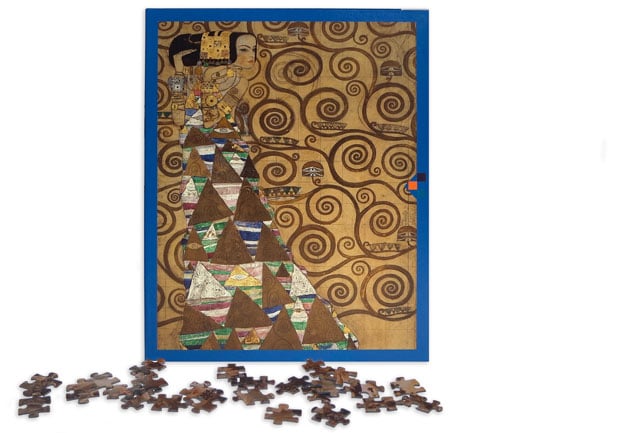
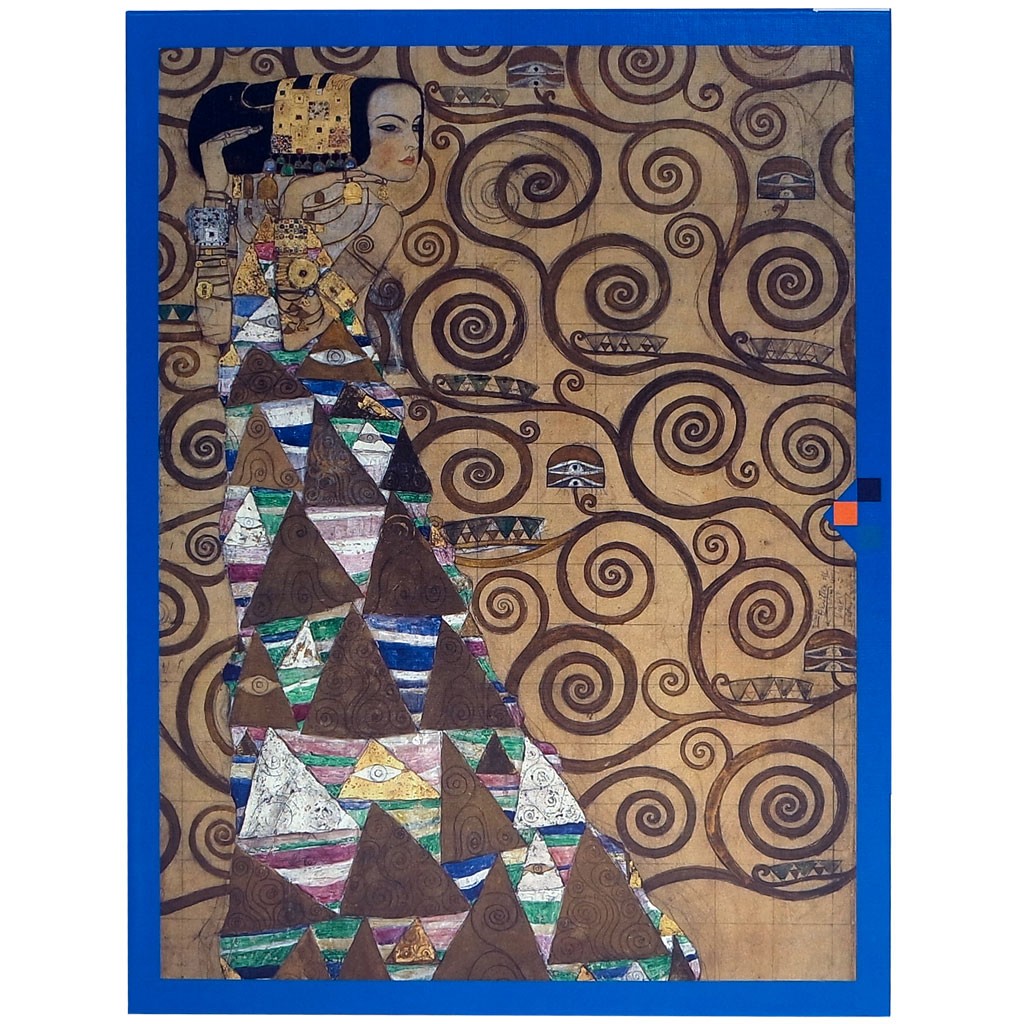
Discover one of the Viennese master’s most evocative masterpieces. The 1000-piece Klimt The Waiting puzzle from Impronte Edizioni lets you relive the decorative splendor of gold, inspired by Byzantine mosaics.

Questo puzzle è momentaneamente esaurito.

Nel frattempo, ti suggeriamo alcuni puzzle d’arte che potrebbero piacerti!

Altri puzzle di Klimt

Puzzle Labbraccio Di Klimt 1000 Pezzi
Klimt’s The Embrace Puzzle – 1000 pieces
24,90
Klimt The Family Art Puzzle
Klimt The Family Puzzle – 1000 pieces
25,00
Puzzle Gustav Klimt
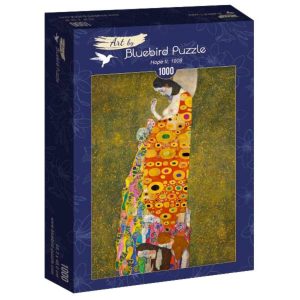
Puzzle Gustav Klimt – Hope II
25,00

Puzzle Features

The Klimt puzzle The Wait is a wonderful opportunity to discover the great art of the master of the Viennese Secession.
Through this puzzle, we want to entertain and excite you with the master’s colors, discovering piece by piece the golden details of this stunning twentieth-century fresco.

Klimt was one of the greatest artists of the decade between the nineteenth and twentieth centuries. Indeed, he founded the great Austrian school of art, which gave rise to the genius of Egon Schiele.
Klimt’s art is characterized by the search for beauty and the symbolic imprint of his paintings.
We have chosen Klimt puzzles to allow you to enter a golden and emotionally charged world together with Klimt’s beautiful works.

The Klimt Puzzle: Waiting in Detail

The 1000-piece Klimt The Waiting puzzle from Impronte Edizioni is a splendid example of one of the subjects most appreciated by art lovers.
The painting we are offering is one of the Austrian artist’s greatest masterpieces.

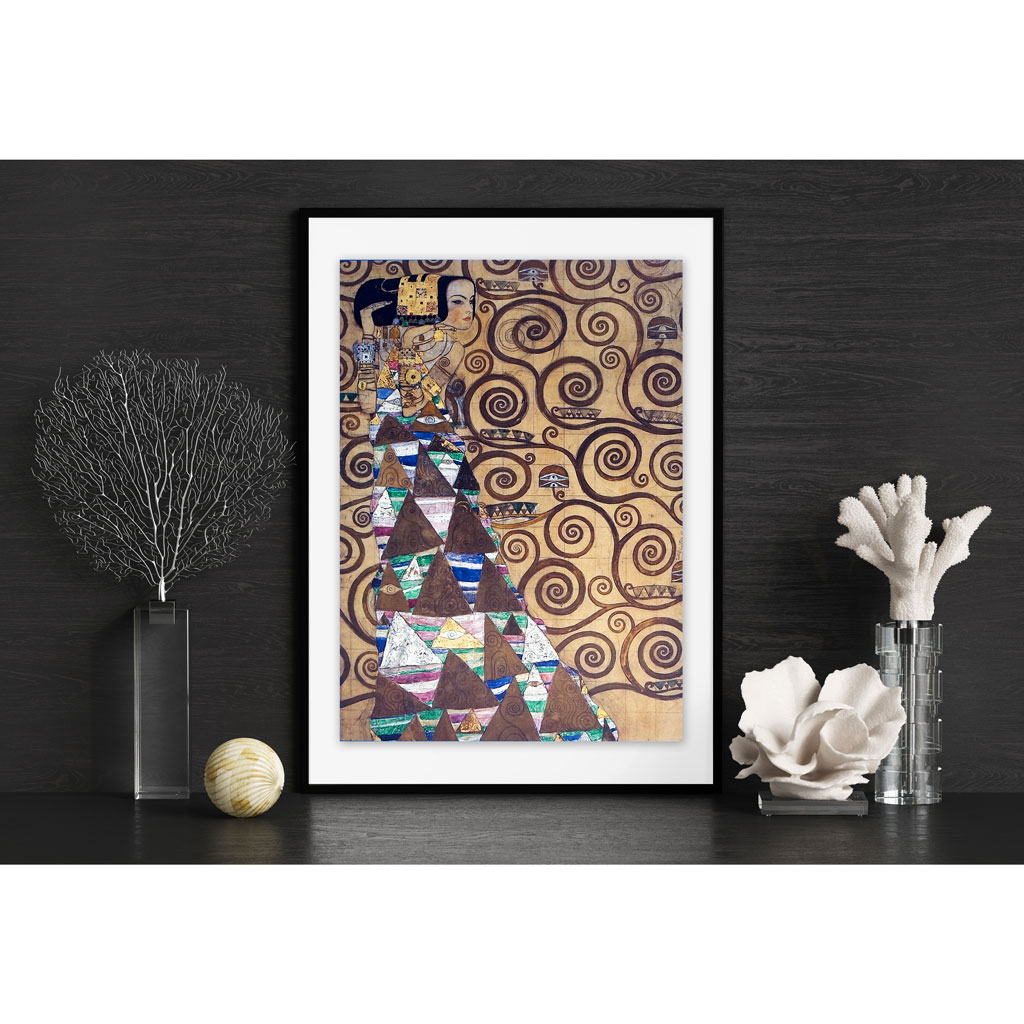
The edition we were looking for has a strongly vertical layout and lends itself to being hung in a long vertical frame with a magnificent passe-partout.
The colors of the puzzle are very bright and manage to strongly convey the brilliance of gold typical of Byzantine art.
The details of the Klimt Waiting puzzle image are of excellent quality , as are the puzzle pieces which are precisely cut and allow for an excellent fit.
The puzzle is presented in a carefully crafted package and is not overly large, making it a perfect gift for a loved one.

Number of Puzzle PiecesNumber of pieces
1000
Puzzle BrandsBrand
Footprints
Editions
Puzzle DimensionsPuzzle dimensions (cm)
68 x 48
Puzzle Box DimensionsBox dimensions (cm)
31 x 24 x 6.5

Well finished box
Wonderful gift idea

Splendors of Gold
Bright colors

1000 pieces
Standard grid

Description of the artwork

We have chosen the Klimt puzzle, the wait, to help you discover, piece by piece, the beauty of the Austrian master’s works.

The brilliance and magnificence of Byzantine art in Ravenna left a profound mark on Klimt’s stylistic expressions and in this work it is evident how the gold and colours of Ravenna’s mosaics influenced Klimt.
In fact, Klimt visited the Byzantine Italian capital twice during the early 1900s.
Along the streets of the city of Ravenna he experienced the splendour of golden mosaics.
It was from this inspiration and his enduring passion for gold that Klimt created the two-dimensional, almost mosaic-like style for which he is still recognized today.

This stylistic period relates perfectly to the style of puzzles, so Klimt’s puzzles fully depict the full grandeur of the Eastern Roman Empire.
Gustav Klimt, who embodied the very spirit of the glories of the Austrian Empire, which seemed destined for eternal prosperity, died on February 6, 1918, from the effects of a stroke that left him semi-paralyzed. He was thus unable to witness either the unstoppable decline of the vast Austro-Hungarian Empire or the definitive collapse of the Habsburg Monarchy.

Klimt was a leading figure in the Vienna Secession , a movement represented by a group of artists and craftsmen who rejected the traditional, moralistic works of the previous generation. Their new style is often called Art Nouveau .

Klimt created numerous portraits, especially of women, and some allegorical paintings. Although he was a successful decorator, his murals for the University of Vienna sparked controversy because they were even considered ” obscene .”

The Klimt Puzzle: Waiting in Detail

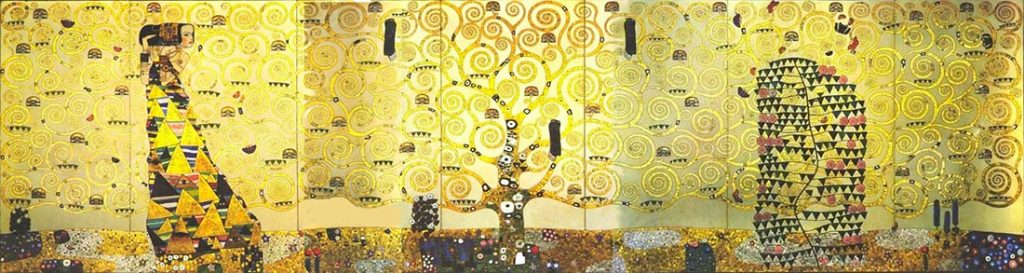
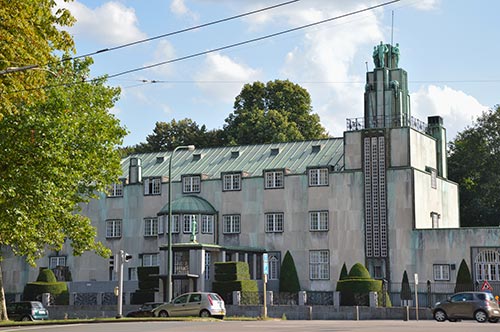
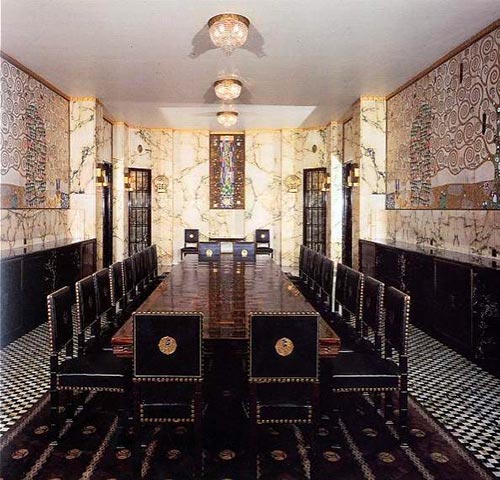
In 1904, the Wiener Werkstätte received their most important commission: the construction of a palace in Brussels for the industrialist Adolph Stoclet . Josef Hoffmann asked Klimt to decorate the dining room, for which the painter designed three panels, later executed in mosaic.

For the short side of the room he designed an abstract, purely ornamental subject, while for the two long sides he created seven-metre-long cartoons, entirely occupied by the curling branches of Klimt’s Tree of Life , placed in the centre of the composition, above a narrow strip of land.

Furthermore, at one end, on both walls, another small tree appears, its triangular leaves overlapping the golden scrolls. At the opposite end, two different figurative scenes are inserted, conceived as pendants.

Klimt's Waiting

In the frieze of the Stoclet Palace, Klimt depicted The Waiting. The work features an Egyptian dancer , her face in profile and her elongated eyes looking into the distance.

Everything about the woman, splendidly adorned with jewelry, becomes decoration, starting with the mass of black hair, which is unnaturally prolonged, offering a visual anchor to the face, the bare shoulder, the hands.
The latter, to which Klimt often attributes particular positions, are oriented with a dance movement in the same direction as the gaze.

Below the head, which is completely off-axis with respect to the rest of the body, the dancer’s dress develops, designed as a long triangle that completely hides the anatomy.
The fabric itself is composed of triangles, softened by the motif of the golden curls of the tree of life, or by the insertion of stylized eyes, an element reiterated several times within the frieze. These are alternated with horizontal bands of different colors, thus transforming the garment into pure ornamentation.

The completion in the frieze of the Stoclet Palace

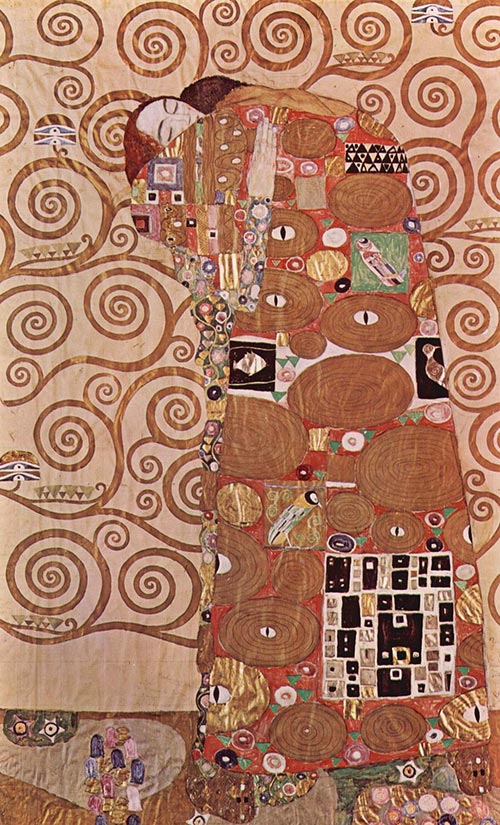
On the opposite wall, corresponding to the Waiting, Klimt depicted The Completion .

It is symbolized by an embracing couple, a reworking of the final scene of the Beethoven Frieze.
Although in this case the ornamental epidemic dominates, every aspect is conceived in explicit opposition to the dancer of the Waiting .
While her figure appeared icy and caught in a moment of suspension, the man and woman are depicted in an attitude of peace and fulfillment. The dancer’s dress was composed of geometric shapes that expressed rigidity, while the couple’s outfits, on the other hand, feature circles and phytomorphic motifs.

The frieze for the Stoclet Palace undoubtedly represents the pinnacle of Klimt’s decorative style . The human figures themselves are recognizable as such only by their heads and arms. In fact, three-dimensionality and anatomy are nonexistent, and every other detail is rendered as if it were an arabesque background.
The repertoire of themes is very vast and ranges from animals to geometry, from the plant world to Eastern religious symbolism, from which the motif of the omniscient eye is taken.

The cartoons preserved in Vienna are a precious testimony to the artist’s working method, which he created with the precision of a finished work, using tempera and watercolour colours, gold and silver applications, chalks and pencils.
Furthermore, the surface is dotted with handwritten notes , in which Klimt prescribed changing the orientation of a scroll, or gave concise instructions on how to create a detail, for example asking to use for a portion of the background “some white material, a little raised and smooth. Very white. Not mosaic”.

The panels, made by the Wiener Werkstätte workshops, were assembled in 1911 and are still located in Brussels.

Rediscover the wonder of the Viennese master’s work with Puzzle Arte by building our 1000-piece Klimt the Waiting puzzle from the Impronte Edizioni brand.
Don’t miss this opportunity!

Reviews

There are no reviews yet.

Show reviews in all languages (2)

Be the first to review “Klimt’s Puzzle: The Wait”

Your email address will not be published. Required fields are marked *

Complimenti!

hai una vera passione per l'arte!

Visto che sei arrivato fino a qui, meriti un premio!
Ecco uno sconto del 10% per il tuo prossimo capolavoro! ✨

Cosa se ne pensi di questi puzzle d'arte simili...

Hot Hot

Price range: 25,00€ through 45,00

Select options This product has multiple variants. The options may be chosen on the product page
Hot Hot

Price range: 19,99€ through 49,99

Select options This product has multiple variants. The options may be chosen on the product page