
Novità!
William Dyce was born on Marischal Street in Aberdeen in 1806 as the third and youngest child of a prestigious British family.
He was a Scottish painter and one of the promoters of state art education in Great Britain.
He was also a supporter of the Pre-Raphaelite Brotherhood and played a vital role in their early promotions.
He became famous for his wonderful work in religious art and for his romantic interpretations of history and stories.
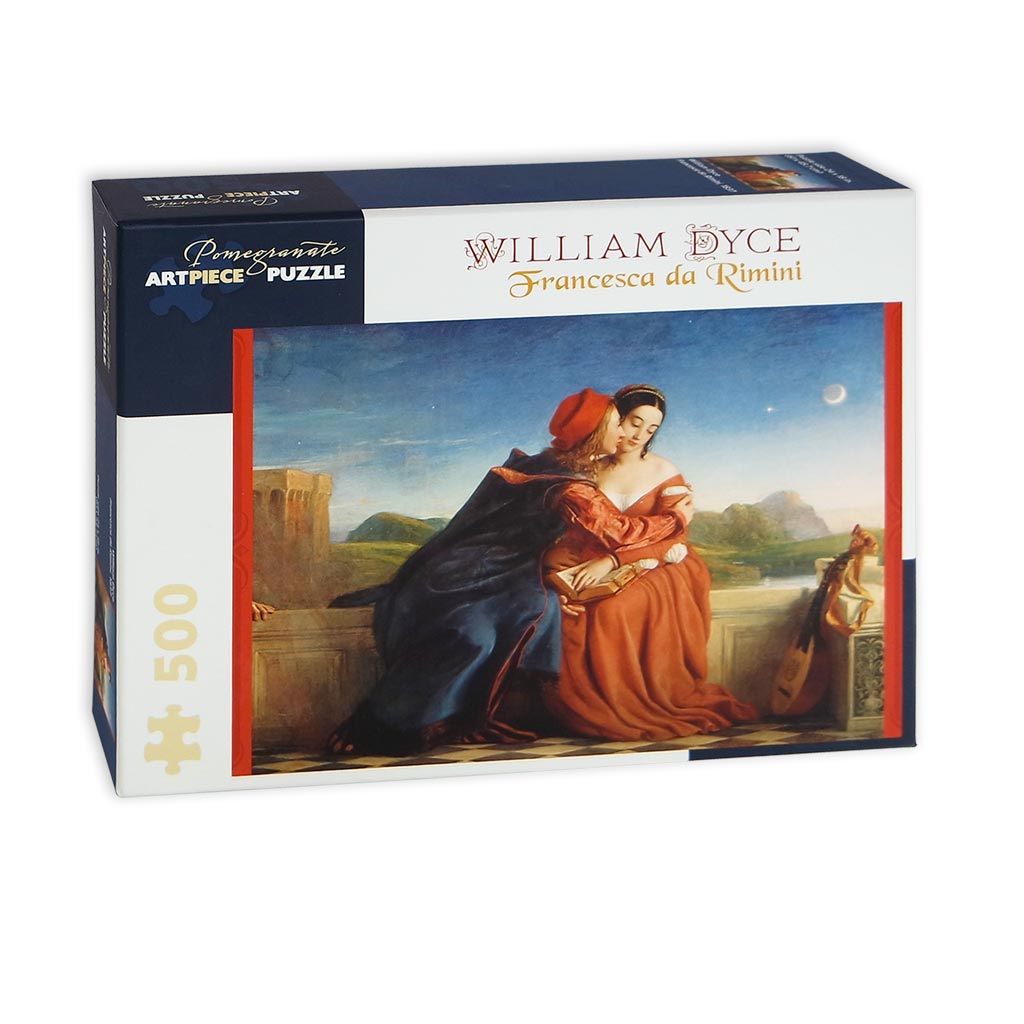
We also have the William Dyce puzzle Francesca da Rimini.
His father, Dr. William Dyce of Fonthill Cuttlehill, was a well-known physician and a distinguished researcher in scientific development.
His mother was the daughter of James Chalmers. She belonged to the most prominent family in the city, having received great respect and honor for centuries in Aberdeen.
Dyce received his education at Marischal College, then at the University of Aberdeen, and finally earned a degree in mathematics at just 16 years old.
His father wanted him to study medicine or theology. In fact, he studied both scientific and religious disciplines, but his main focus was art, particularly painting.
So, at a young age, he secretly began studying art and selling his works. Thanks to these sales, he was able to support himself and move to the commercial area of London.
He was introduced to the president of the Royal Academy, and seeing his love for art, the president sought permission from his father to allow him to study art. He then began making drawings for the Egyptian Hall and later started his career as an apprentice at the School of the Royal Academy.
The British Royal Academy became the launching pad for Dyce’s great work.
Unsatisfied with the system, when he had the opportunity to visit Rome thanks to an offer from Alexander Day, he accepted to move and start a new life in Italy.
He began working and stayed in Rome for 9 months, focusing on the works of Nicolas Poussin and Titian.
After a year, in 1826, he returned home to Aberdeen and decorated his father’s house.
He exhibited his first work “Bacchus Nursed by the Nymphs of Nissa” at the Royal Academy in London in 1827. Later that same year, he returned to Rome to develop the Pre-Raphaelite art style.
In 1828, back in Aberdeen, he painted “Madonna and Child” and other portraits of extraordinary beauty.
After taking a break from painting, he returned to focus on portraits and romantic works, moving back to Scottish territory.
He settled in Edinburgh for 7 years, starting in 1830, and produced about 100 simple yet very vivid and appealing portraits.
Quality was central to his pursuit. Dyce treated portraiture with the same care and attention found in scientific study and artistic research.
After returning to work for the British crown, Dyce was commissioned to decorate the Queen’s Robing Room in the palace.
He chose Arthurian legends as the subject, but faced some difficulty adapting the courtly love of Merlin’s stories to Victorian customs.
The Arthurian legend became popular later in the Victorian period, but when Dyce received the commission to decorate the room in 1847, it was still an obscure topic.
The legend soon became a serious challenge for Dyce, as it involves the unfaithfulness of a queen, causing the fall of a kingdom.
After initially experimenting with a narrative sequence where the story would unfold across the room’s panels, Dyce abandoned it in favor of an allegorical approach.
In their finished form, Dyce’s frescoes depict scenes from the Arthurian legend meant to exemplify the virtues inscribed below them.
The actions of the figures in his frescoes seem to convey qualities to the modern viewer whose status as virtues is uncertain. Indeed, the connection between the episodes of the Arthurian legend and the virtues they represent is sometimes difficult to discern.
However, the virtues represented are Mercy, Hospitality, Generosity, Religion, and Courtesy.
Dyce was working on the Westminster frescoes when the building collapsed.
Returning home, he ended his life without completing the great Arthurian work in the House of Parliament, and on February 14, 1864, he died at his home in Streatham.
He was buried at St Leonard’s Church, Streatham. A nearby fountain, designed in neo-Gothic style by Dyce, was later dedicated to him by the parishioners.