
 Hot
Hot
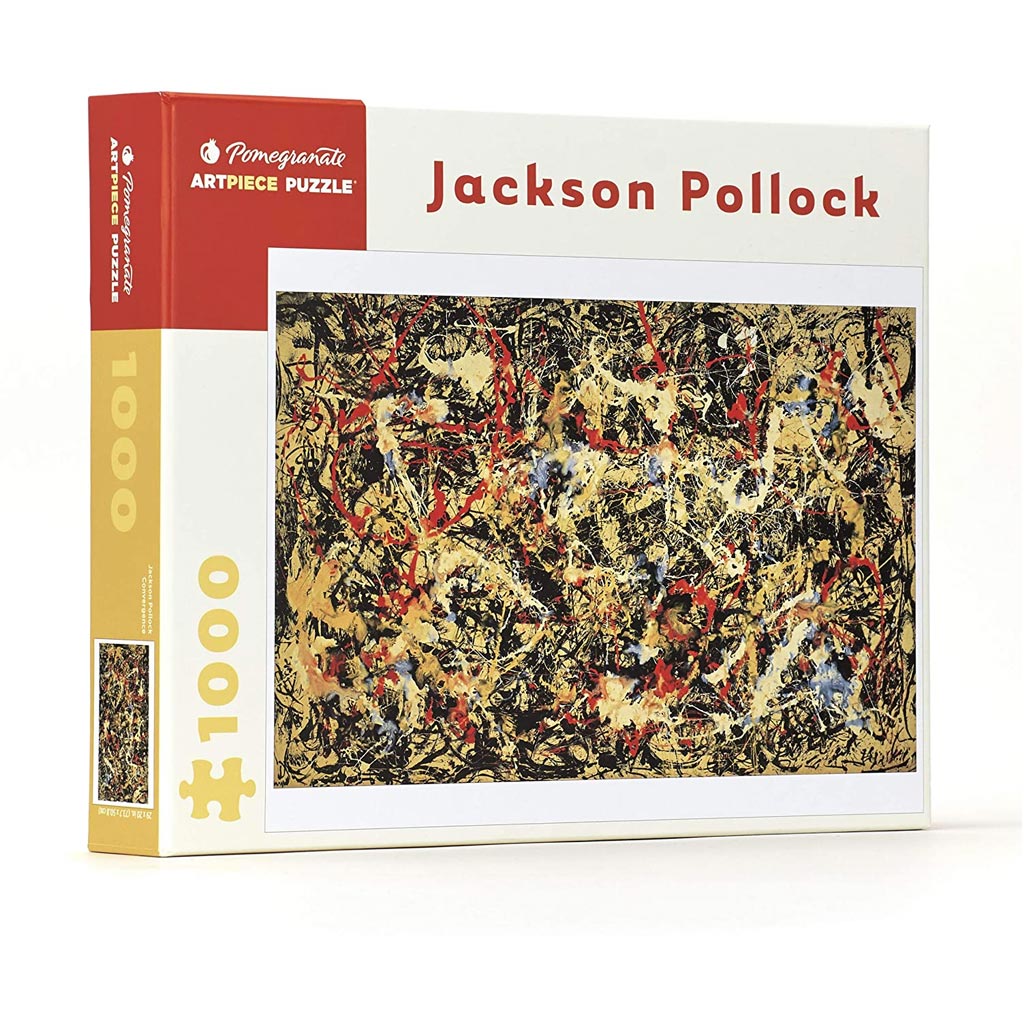
Discover with us our Pollock puzzles and embark on a new experience with color and the intimacy of contemporary art.
Indeed, Pollock’s art is characterized by an extraordinary expressive force, related to gesture as the ultimate manifestation of his artistic inner self.
For this reason, Pollock is considered one of the greatest artists of the postwar era. His art is globally known as Action Painting. We have chosen Pollock puzzles to allow you to enter with us into the grand canvases created using the “Dripping” technique.
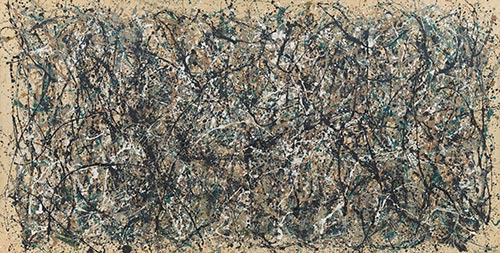
What strikes in Pollock’s canvases is the extraordinary capacity for emotional expression through a semi-random artistic language, which in an abstract method manages to transport the observer into his own intimacy.
In particular, we want you to discover his greatest masterpiece through the Pollock Convergence puzzle.
Contemporary art is not only a movement felt in the Old Continent. Indeed, Europe was heavily affected by war, and the surviving generation worldwide shared the same deep unease and the same inability to communicate.
Informal art, “the Modern Art,” in a sense, is precisely the art of incommunicability, or, from a less pessimistic perspective, the art of attempting to communicate again.
There are many interesting informal developments, both in Japan—where the alliance with Nazi Germany had caused a severe crisis of values and identity, especially after the atomic bombings of Hiroshima and Nagasaki—and in the United States.
The latter emerged victorious from the war, but with the awareness that it was necessary to rebuild a fruitful political, economic, and cultural dialogue with the Old Continent.
Contemporary art is, unsurprisingly, extremely sensitive to fashion and market trends, with which it almost always establishes a very close interdependent relationship.
This does not mean, of course, that art is subservient to certain trends or specific development models, but simply that it adopts the same rhythms.
Thus, there may be artistic expressions of violent rupture against globalization and mass capitalist society, but they will inevitably be consumed by that very same globalized society, another phenomenon it produced.
Jackson Pollock, perhaps the greatest American artist of the postwar era, stated:
- For me, modern art is nothing more than the expression of the ideals of the age in which we live. I believe new demands require new techniques. Modern artists have found new ways and means to assert their ideas.
- It seems to me that a modern painter cannot express our era—aviation, the atomic age, radio—using Renaissance forms or those of another past culture.
- The modern artist lives in a mechanical age and we have mechanical means to represent objects of nature: film, photography.
- The modern artist works with space and time and expresses his feelings, rather than illustrating them.
American contemporary art, on one side linked to the various pragmatic traditions of the American people, and on the other, strongly influenced by many European artists, is collectively defined as Abstract Expressionism.
This term refers to a certain chromatic intensity, characteristic of Expressionism, which is however placed in an abstract context, meaning devoid of immediately recognizable figurative references.
Within this vibrant movement, particular importance is given to Action Painting.
Ahead of European developments, Action Painting emerged in the first postwar decade, characterized mainly by strong gestural content and nonconformism, often bordering on provocation or mockery.
The greatest exponent of Action Painting is undoubtedly the American Jackson Pollock, whose reckless life, prematurely ended by a car accident, symbolically connects to the Bohemian and “cursed” artists of the early 20th century.
From the start, he was strongly influenced by Mexican folk painting and by Native American ritualistic art, practiced for ancient magical-propitiatory purposes.
However, in 1937, not yet thirty, Pollock was already severely affected by alcoholism and underwent various psychoanalytic therapies.
In the medical environment, near the scientific theories of Carl Gustav Jung—one of the fathers of modern psychoanalysis alongside Freud—the young artist had the opportunity to encounter the latest European cultural avant-gardes, which immediately fascinated him.
From that moment, Jackson Pollock developed the drive to find a personal and unique method of expression.
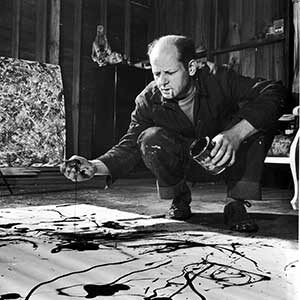
In 1947, Pollock perfected the “dripping” technique, consisting of eliminating the brush and replacing it with more or less regular drops of pure synthetic paint on canvases or cardboard laid on the floor.
This method produces almost entirely random results, generating filamentous tangles of color overlapping in a chaotic network of splashes, drops, and drips.
As clearly seen in his paintings, the visionary and allusive subject merges with the new technique into a single, captivating web of marks. Pollock wrote:
I paint on the floor, but it’s not unusual. The Orientals did it. The paint I use is almost always liquid and very fluid. I use brushes more like sticks than real brushes. The brush never touches the canvas surface, it stays above it.