
 Hot
Hot
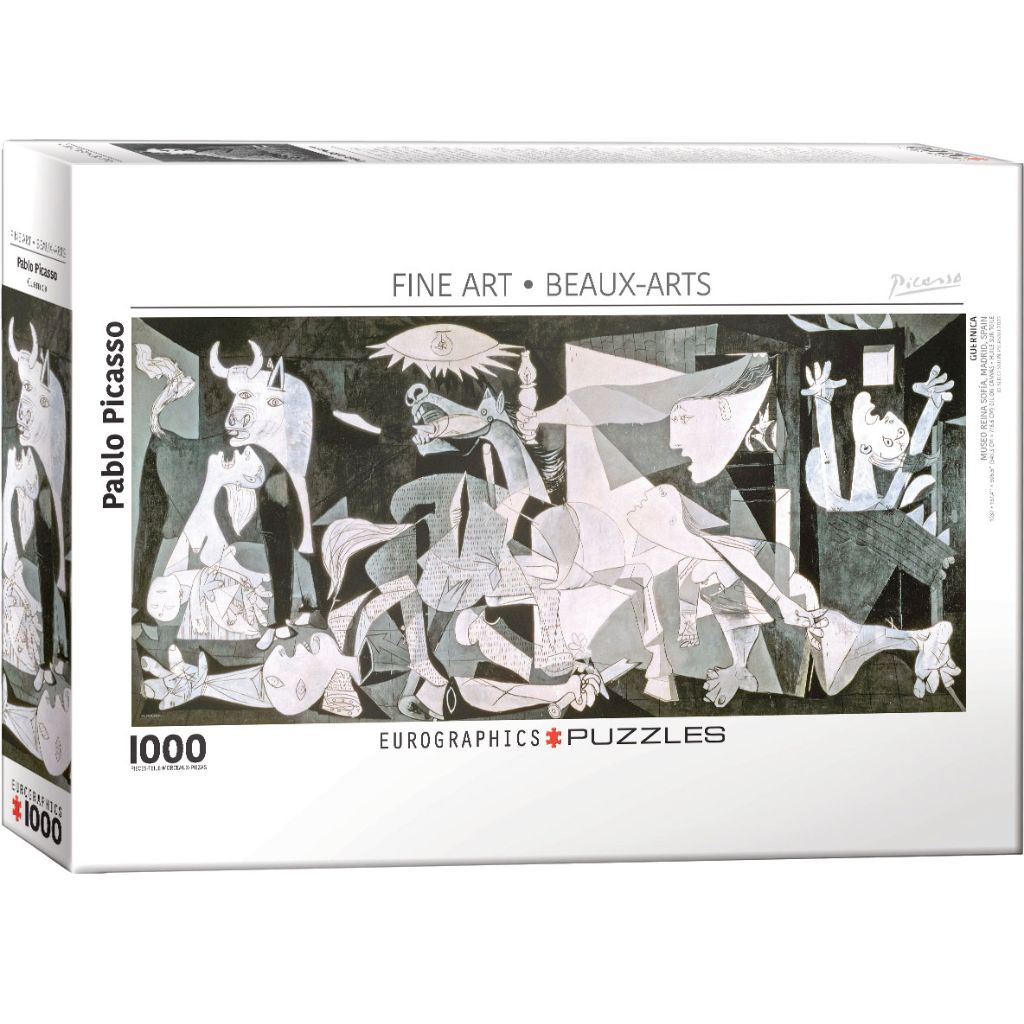
Discover with us our Puzzle Picasso and immerse yourself in the story of the greatest painter of the 20th century. Picasso was not only a painter of the Cubist period, he was undoubtedly one of the most skilled and innovative figures in all of art history.
His painting ability, even from a very young age, brought him alongside the greatest modern painters.
But like a great singer of our time, Picasso had the instrument in his hands to communicate his feelings. His art is a hymn to feelings. A wonderful song through the colorful styles and periods of the artist.
Admiring a work by Picasso is like living a piece of his life.
Pablo Diego José Francisco de Paula Juan Nepomuceno Crispín Crispiano de la Santísima Trinidad Ruiz y Picasso is the very complicated full name of the man who, more simply, went down in history as Pablo Picasso, choosing to adopt, as allowed by Spanish law, his maternal surname.
Picasso was born on October 25, 1882, in Malaga. His father, a teacher at the local art school, introduced him early to artistic apprenticeship.
The young boy showed extraordinary talent, so much so that at just fourteen he exhibited a first painting in a Barcelona exhibition, gaining the amazed approval of critics.
In old age, when his fame had become universal, he liked to repeat:
At thirteen, I painted like Raphael. It took me a lifetime to learn to paint like a child
Imaginative, restless, and independent by nature, the artist soon distanced himself from his family and undertook numerous journeys in beloved Catalonia.
Once back in Madrid, where he attended the prestigious Royal Academy of San Fernando, he devoted himself particularly to studying the great Spanish painters of the past: Velázquez and Goya.
At the end of the 19th century, he moved to Barcelona. These were years of great inner confusion. But they were also the years in which Picasso laid the foundations for his extraordinary ability to devote himself to any type of artistic expression.
In October 1900, the artist, not yet twenty, went for the first time to Paris, where he remained for almost half a century.
In the autumn of 1901, Picasso’s painting, which until then had not yet developed a personal style, oscillating between admiration for Cézanne and post-impressionist themes, had a first decisive turning point, also influenced by the emotion caused in the artist by the suicide for love of his friend Carlos Casagemas.
This inaugurated the so-called Blue Period, which lasted until 1904. As the name suggests, this type of painting is entirely based on cool colors (blue, gray, turquoise), as if the artist’s eyes were veiled by a blue crystal and his heart by a perpetual melancholy.
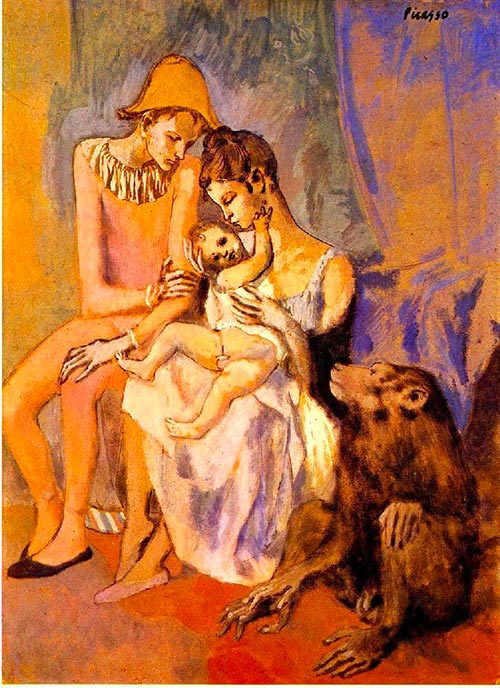
Starting in 1905, Picasso’s palette suddenly changed tone, and the desolate sadness of the blues was replaced by the warm shades of pink. Thus began the second phase of the master’s artistic maturation, the so-called Pink Period.
This period, of intense production but short duration, constitutes the logical continuation of the previous one. The world of the exploited and marginalized of the Blue Period is replaced by subjects drawn from the circus and acrobat environment.
The last months of 1906 mark the so-called Black Era, during which the artist became interested in African and Polynesian sculpture, seeking in them the expressive force of a spontaneous and uncorrupted humanity, not yet contaminated by excessive ideology and social constraints.
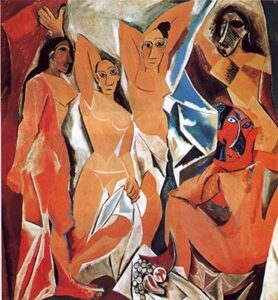
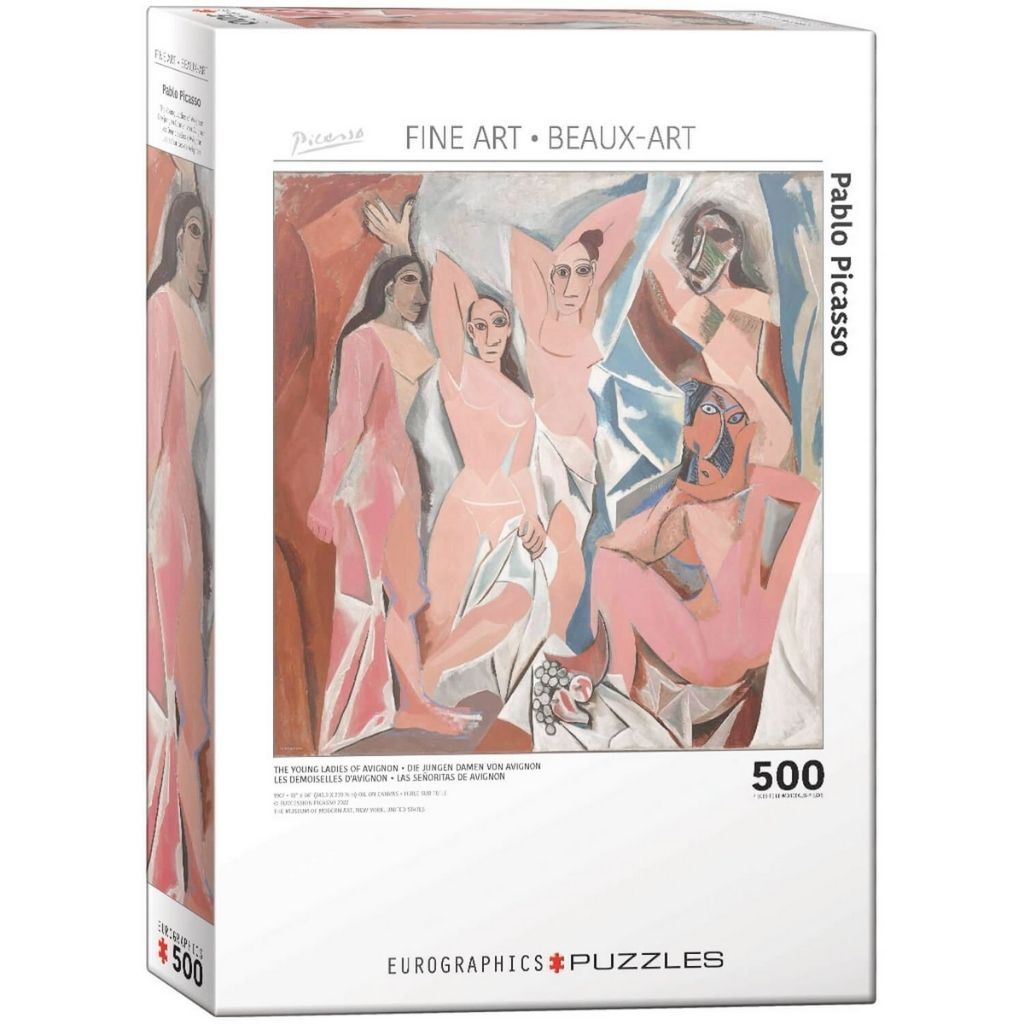
In 1907, finally, the artist exhibited Les Demoiselles d’Avignon, considered the founding work of the Cubist movement.
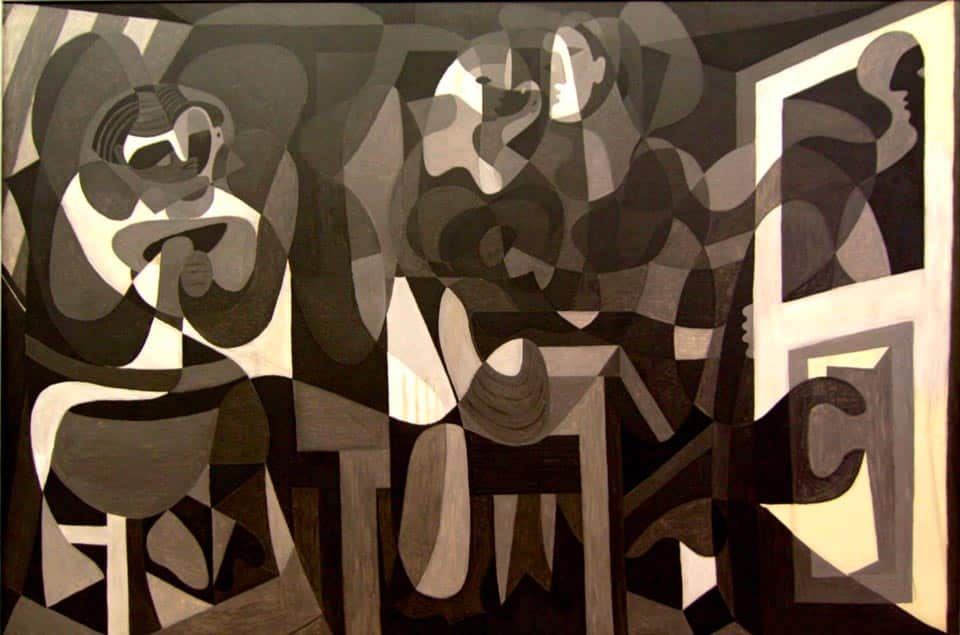
The analytical phase of Cubism (1909-1911), during which Picasso’s and Braque’s paintings, deliberately unsigned, often appear indistinguishable, was followed by the synthetic phase (1912-1913), during which the stylistic differences between the two artists became clearer.
Picasso immediately appears as a torrent. His extraordinary imagination and innate drawing talent made him proceed with brilliant intuitions.
This is the happiest period of Picasso’s Cubism.
The colors became bright and the surfaces perfectly flat. The use of collage, that is, gluing objects and heterogeneous materials (wood, paper, straw) to the canvas, gives each composition a new and provocative meaning.
The first, tragic World War (1914-1918) also swept over Cubism. In the postwar period, Picasso alternated large monumental paintings with explorations of Synthetic Cubism, also taking an interest in graphics and set design. The artist showed his full maturity after this sad period.
In 1929 he participated in the first Surrealist exhibition at Galerie Pierre in Paris, and in the 1930s he expanded the Surrealist experience to sculpture, introducing imaginative constructions in wire or heterogeneous materials.
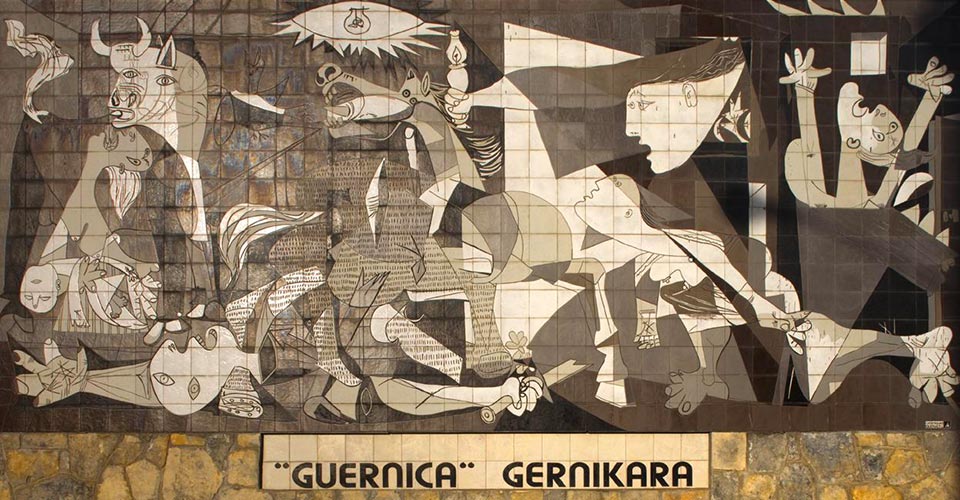
Picasso’s political stance was always democratic and anti-fascist. Indeed, in Hitler’s Germany, some of his works, along with many other pieces by great German Expressionist artists, were publicly burned in squares as examples of degenerate art.
Throughout his artistic life, he achieved great fame and admiration; today his signature is a symbol of modern art.
Pablo Picasso died in Mougins, in one of the many properties where he used to stay intermittently during the year.
It was April 8, 1973, and the news spread around the world in an instant. With him died the greatest artist of the 20th century.