Novità!
 Hot
Hot
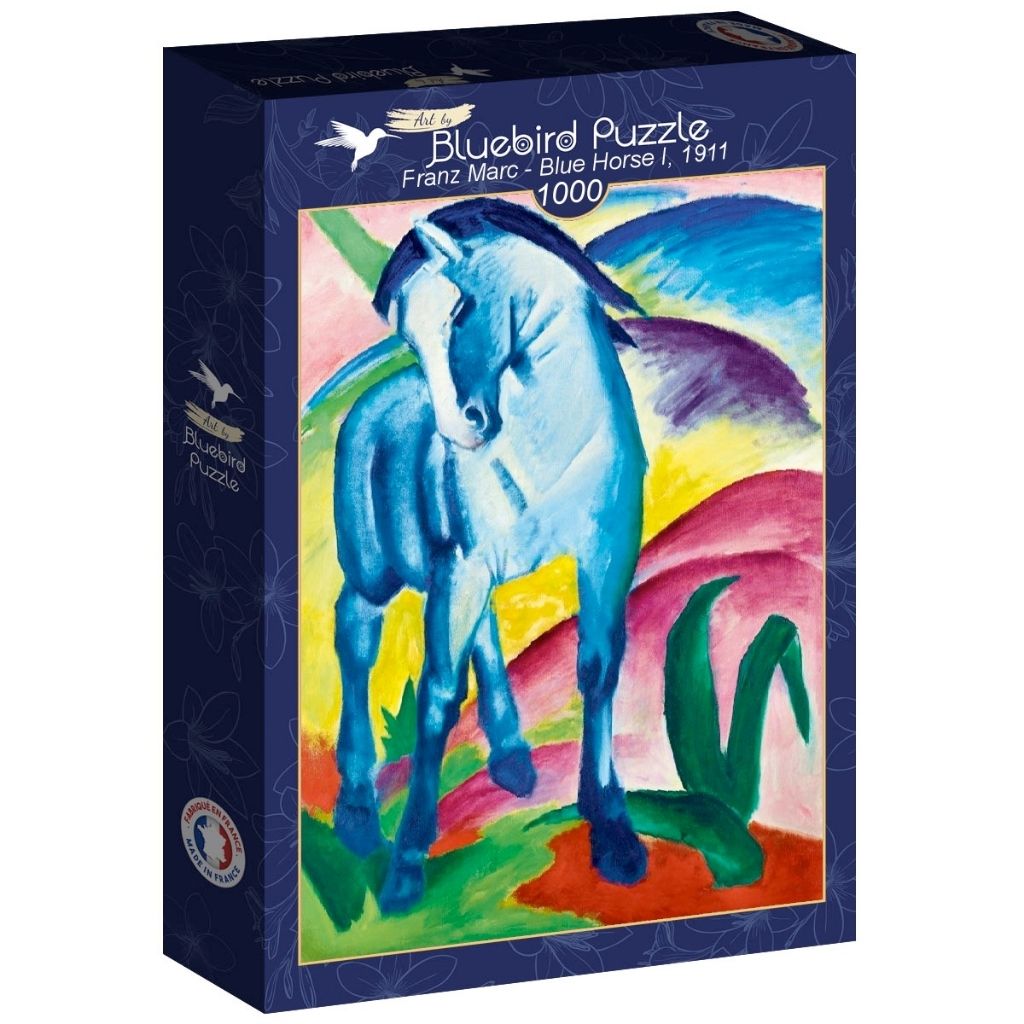
Discover with us our Marc puzzles and immerse yourself in the art of the early decades of the twentieth century. In fact, Franz Marc was one of the most important painters of the last century, revolutionizing together with Kandinsky the very concept of artwork. With Marc puzzles you can enter a new world of art full of emotions and inner exploration.
His painting skills and continuous artistic and intellectual research led Franz Marc to become a great explorer of modern artistic techniques and styles.
His art is emotion. A continuous search among color, subjects, and forms.
For us at Puzzle Arte, Marc puzzles are a wonderful tool to intimately enter the artworks of the twentieth century.
Try Marc puzzles yourself and relive the early years of the great German artistic movement Der Blaue Reiter.
Franz Marc born in Munich on February 8, 1880, was a highly important German painter.
Franz Marc is considered one of the most representative painters of the 20th century and one of the most significant figures of expressionism and German abstractionism.
Art is nothing more than the expression of our dream; the more we surrender to it, the closer we get to the inner truth of things, to our dream life, to real life that despises questions and does not see them.
However, Franz Marc died very young, at only 36, on the battlefield of Verdun in France during World War I. It was March 4, 1916, and he was specifically in Braquis, east of Verdun; he was on reconnaissance on a horse, his favorite animal also in art.
A shard from who knows where and from who knows which explosion mortally wounded him. Fate had it that on that very day, the German government had sent a letter of exemption that would have removed him from the front for artistic merits. Marc had volunteered for World War I, wanting to be close to his country and fight for shared ideals. Even during the war, he never stopped drawing; he always carried a notebook for sketches.
As a young man, he studied theology and philosophy before focusing his efforts solely on the Academy of Munich. Religion was indeed a dominant element in both his life and his art. In the early stage as a painter, the beauty of nature was his favorite model.
Franz was born to the German painter Wilhelm Marc and his wife Sophie Maurice, from whom he received a strict upbringing and for a short time nurtured the idea of becoming a pastor.
However, in 1899, his theology studies gave way to philosophy at the Ludwig Maximilian University of Munich.
The young Marc’s uncertainty continued and led him in 1900 to leave the University to enroll in the Academy of Fine Arts in Munich and devote himself to painting.
In 1910 he held his first solo exhibition at the Kunsthandlung Brakl in Munich and came into contact with members of the Neue Künstlervereinigung München and managed to join the group.
Even the experience with the Neue Künstlervereinigung München lasted only one year, because when at the group’s third exhibition the jury rejected Kandinsky’s abstract work Komposition V, Marc and Kandinsky left the NKM, founding Der Blaue Reiter.
Finally, in 1914, at the onset of the war, Marc enlisted as a volunteer. At the front, he made sketches and aphorisms, collected in the volumes Briefe aus dem Felde and Aufzeichnungen und Aphorismen.
In 1916 he was exempted from military service for artistic merits, but on the very last day of service, March 4, he fell, struck by two shrapnel fragments near Verdun.
Franz’s early paintings are landscapes and portraits in an academic style, but his major reference throughout his short career was the work of Van Gogh.
Van Gogh is the most authentic painter, the greatest, the most moving I know. To paint a bit of the most ordinary nature, putting all your faith in it – this is the supreme result… Now I paint… only the simplest things… and the mystery of nature is revealed.
He traveled to Italy and stayed in Paris, visiting museums and copying many paintings, the traditional way for young painters to assimilate various techniques.
Marc seeks to harmonize with nature, trees, animals, and the air. He sees the animal as a metaphor for purity and innocence; he isolates the creature in a rural context.
Indeed, his goal is “the animalization of art.” Consequently, he examines in detail the “internal mechanisms” of animals: this led him to reflect on how a horse, an eagle, a deer, or a dog sees the world and to attempt to depict the landscape as seen by the animal rather than as we see it with our eyes.
Moreover, Marc places great importance on color. According to Marc, Blue is the masculine and spiritual principle. Yellow is the feminine, gentle, cheerful, and sensual principle. Red, brutal and heavy, must be countered and surpassed by the other two.
At the end of 1911 Marc and Vassily Kandinsky created “Der Blaue Reiter“, an art group of very short duration but of great historical impact.
The name, Der Blaue Reiter, we found, Marc and I, in front of a cup of coffee under the pergola of Sindelsdorf: we both liked blue. And Marc liked horses, I liked riders. And so the name came out by itself.
Der Blaue Reiter proposed an art where the main component was the inner expression of the artist, which, at the extreme, could even completely ignore external reality; from this, a fully abstract painting was a short step: it was Wassily Kandinsky who first chose the path of total abstraction.
In contrast, the technique of the painters of the Die Brücke group was to make external reality expressive so that it coincided with the inner resonances of the artist.
As a true expressionist, Marc gave a specific emotional meaning to each color in his works: blue was used to represent masculinity and spirituality, yellow symbolizes female joy, while red contains the roar of violence.