
Novità!
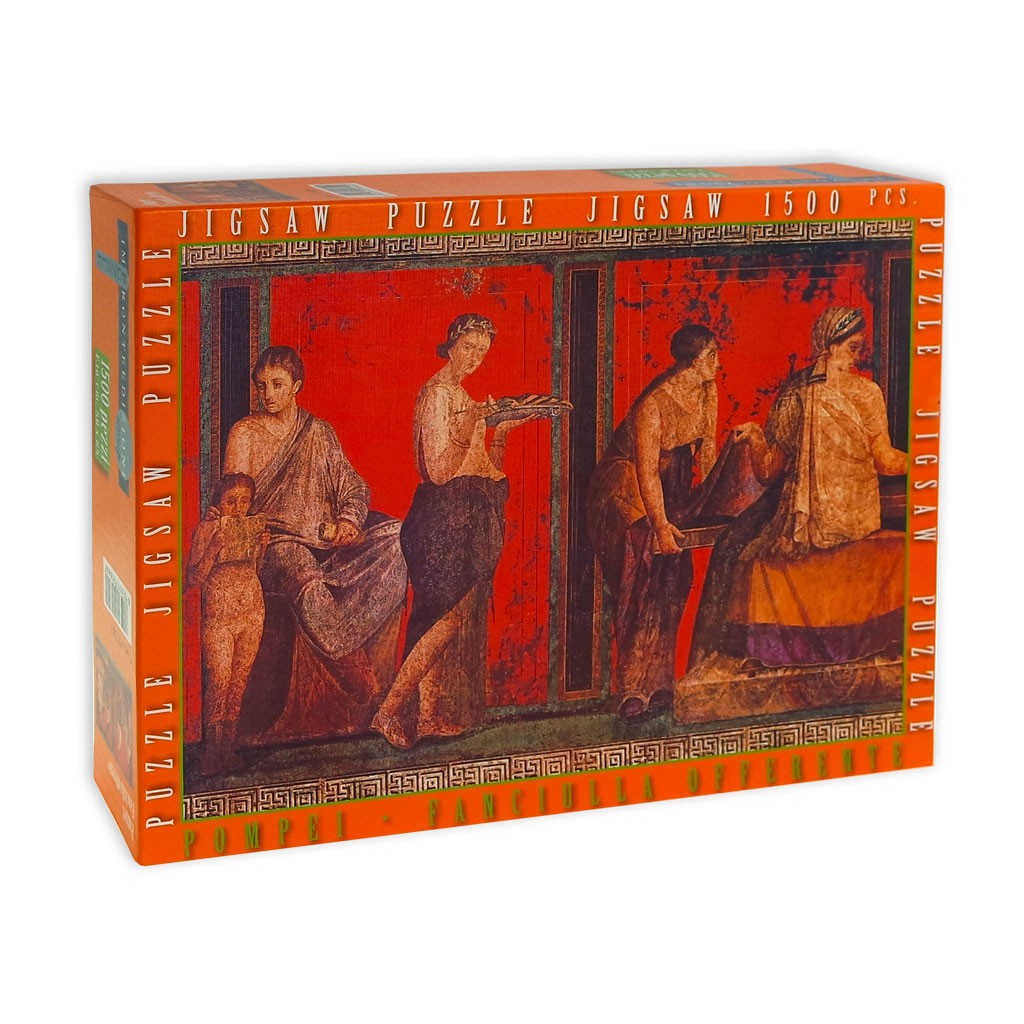
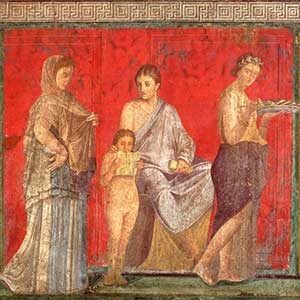
Discover with us our Pompeii fresco puzzles and immerse yourself piece by piece in classical art puzzles.
The art of the Roman period is characterized by the exaltation of the cultural and social systems of the empire.
For this reason, we have selected Pompeii fresco puzzles to allow you to enter the real world of the Romans and discover the magnificent Pompeian frescoes one piece at a time.
Observing these works in all their details, you embark on a fantastic journey through the mural paintings of Pompeii.
From the marvelous Pompeii frescoes, scholars began an extensive study on the complex relationship between the Roman Empire and art.
The Romans had a relationship with art that we would today define as very problematic. Indeed, the Romans were decidedly more interested in practical matters than in abstract ones.
Their character, harsh and sober, was shaped over centuries of almost continuous wars: starting with the conquest of Lazio, then Italy, and finally the Mediterranean countries and northwestern (up to England) and northeastern Europe (up to the Danube).
Thus, artistic and philosophical discussions, so dear to the Greeks, were considered a waste of time and idleness in a dynamic and structured system like that of Rome. According to the Romans, the arts only led to relaxation and softness of morals, abandonment of traditions and customs practiced by their ancestors, who had made the homeland great.
The objects that the Romans, especially during the Republican era, surrounded themselves with were made of humble materials and modest craftsmanship.
It was mainly the exceptional concentration in Rome of immense wealth from the plundering of temples and cities of conquered peoples that forced and accustomed the Romans to a continuous relationship with art.
A large quantity of precious metals and money flowed into Rome after the conquest of southern Italy (Magna Graecia), while Hellenistic artworks were brought to the capital following the capture and sack of Syracuse.
The final conquest of all Hellenistic territories with the takeover of Greece in 146 BC brought Rome into direct contact with the land where classical art had been born, grown, and prospered, and later spread Hellenistic art.
The concentration of art treasures in Rome and increasing contact with very diverse peoples gave rise to eclectic collecting. Anything that seemed valuable—because it was made of precious material, because it was rare or unique, or because it was created by a renowned Greek master—was collected.
However, the Romans, bound to the cult of ancestors and the rules passed down by tradition, always felt uneasy claiming to be art experts. Rarely did they show this sensitivity, always masking it with feigned indifference and avoiding giving it too much importance.
For example, the case of Cicero (106-43 BC), one of the most eminent political, literary, and philosophical figures of the late Republic, is emblematic.
He was also a great collector, but during his speeches against Verres (governor of Sicily from 73 to 71 BC) he justified himself and his artistic knowledge by arguing that a practical necessity had led him to investigate artistic matters as well.
Verres had indeed plundered every kind of art he found in wealthy Sicily. Whenever Cicero needed to mention a Greek sculptor’s name during the trial, fully aware of his audience’s suspicion toward such subjects, he avoided criticism by hiding behind the boldest rhetorical artifices.
For example, when needing to name Polykleitos, he had to rely on his assistant’s prompt:
“They called them Canefore, but who was their author? Who was it? Ah yes, good you remind me, it was, they said, Polykleitos.”
This attitude continued during the Imperial period, although a distinct Roman art already existed.
This art was mainly expressed in forms adhering to tradition: portraiture, which realistically immortalized ancestors’ features; large public works created for communal and state use; reliefs and honorary architectures celebrating events or specific figures.
This period also saw a major revolution in art techniques: extensive engineering studies and elaborate architectural plans; the birth of the semicircular arch and vault; near-obsessive study of masonry and brickwork; mathematical laws and hydraulic rules applied to marvelous aqueducts.
Because state interest often prevailed over individual recognition, the names of creators of artistic works were rarely remembered, and most Roman art remains anonymous.
When discussing unknown artistic personalities, the term «Master» was used.
The philosopher Seneca (c. 4 BC–65 AD) would repeat that artists are “dispensers of luxury.” The Christian Latin poet Prudentius (348–413 AD), in his *Contra Symmacum*, addressing the debated issue of the Altar of Victory, claimed that Rome suffered from three evils: paganism, literature, and figurative arts.
Between the end of the 4th century and the beginning of the 5th century, Christianity replaced pagan cults, and the Empire itself had become Christianized.
It was the representatives of the new faith, also carriers of an original culture, who embraced a more intimate and spiritual relationship with art, a sign and manifestation inherited from the legacy of the dying empire.