
 Hot
Hot
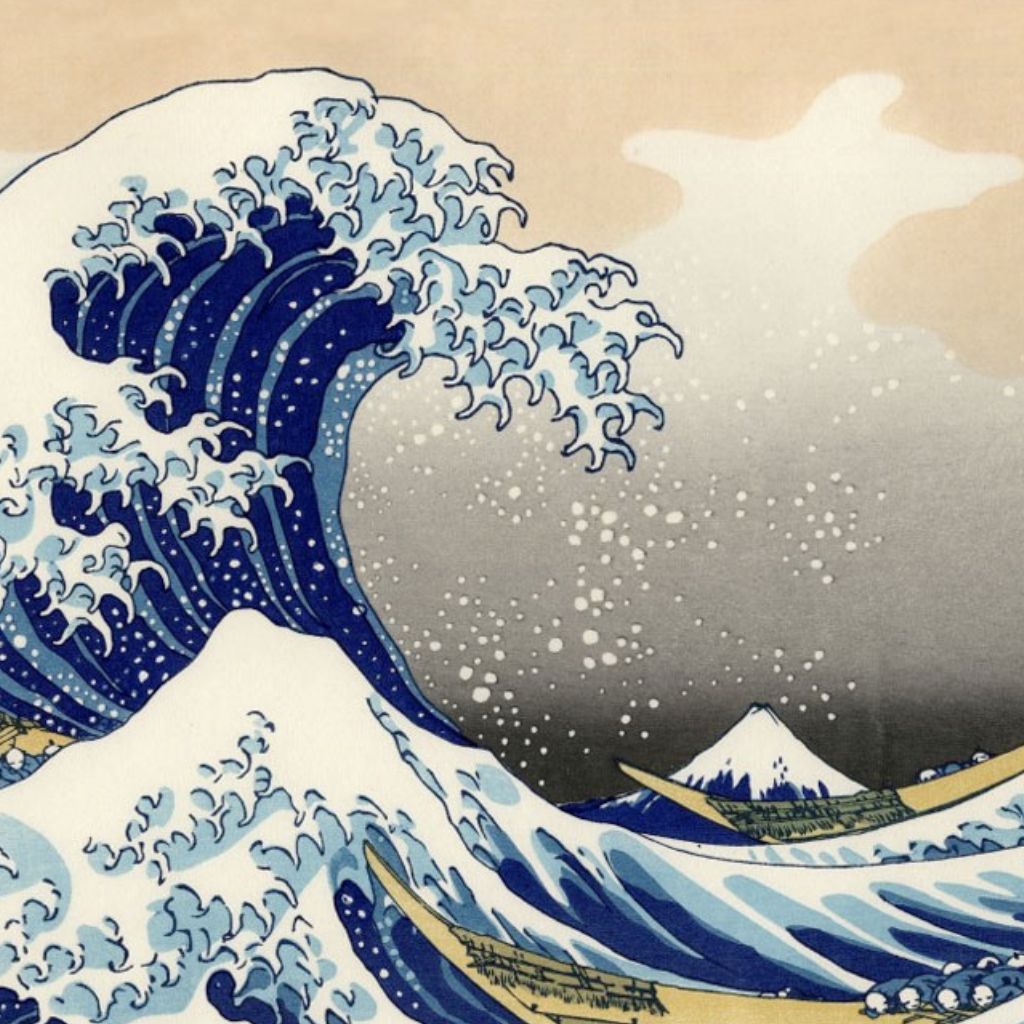
Hokusai Wave Puzzle
Price range: 23,90€ through 25,00€
Select options
This product has multiple variants. The options may be chosen on the product page
Discover our Hokusai puzzles with us and enter the wonderful world of Japanese art with the colors and strength of the great Japanese master.
Through the Hokusai puzzles you will in fact be able to discover the artistic world of one of the greatest artists in all of history.
The puzzle is one of the most fun and fascinating ways to discover art piece by piece. For this reason, with Hokusai puzzles you can discover the details of his most beautiful works.
By building the Hokusai puzzles piece by piece you will immerse yourself in the world of Japanese painting and the Far East.
Hokusai’s production can be said to be immense: paintings, drawings, individual prints, illustrated books, perhaps in an incalculable number. A sort of frenzy similar to an insatiable hunger forced him to practically never abandon the brush and colors.
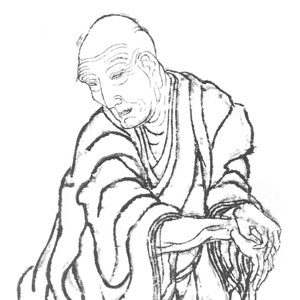
Born on October 31, 1760 in the Honjo district in the Katsushika area, near the Sumida River in the capital of Japan Edo (today’s Tokyo), his childhood name was Tokitaro.
There are still uncertainties regarding his parents. It seems that the mirror polisher Nakajima Ise, who served the shogun Tokugawa and with whom Hokusai spent his childhood, was actually an adoptive father; it is also possible that Tokitaro was the result of an illicit relationship between Nakajima and a concubine, a hypothesis that would explain why the young Hokusai was not destined to continue his parent’s profession.
If the adoption story were true, the mystery regarding the identity of Hokusai’s real parents would remain: in fact the hypothesis that his natural father was Kawamura Hichiroemon, an artist known by the name Bunsei, cannot be verified, even though the inscription on the tombstone in the Seikyoji temple in Tokyo, where Hokusai was buried, bears the surname Kawamura.
Regarding the wife of Nakajima Ise, Hokusai’s adoptive mother, she is said to have been the daughter of Kobayashi Heihachirō, one of the protagonists of the Chūshingura, commonly known as “the revenge of the forty-seven rōnin“.
A source of inspiration for numerous literary, theatrical and artistic creations, the Chūshingura was one of the favorite themes of the Japanese public: it told the deeds of some samurai who dedicated their lives to avenging the killing of their lord. Hokusai illustrated this theme once already in 1790 and on other occasions later, therefore the anecdotes reported by the artist’s biographers according to which he repeatedly and publicly stated that he did not
want to deal with that theme which concerned him so closely seem unfounded.
Already during his adolescence Hokusai changed his name for the first time: from Tokitaro to Tetsuzo (“the iron warehouse”). It was during this phase that the young boy was hired as a messenger in a lending book library, a job that we imagine allowed him to reach a certain level of culture that enabled him at least to read the difficult characters of Chinese origin, and it is also credible that this position brought him closer to classical literature and to the most important themes of his country’s cultural tradition.
At about fourteen years of age the young Hokusai began working as an apprentice in a woodblock engraving workshop, where he immediately stood out and already in 1775 began receiving commissions, including the engraving of some plates for a sharebon (“fashion books”, mostly of a licentious nature) by Unchusha Sancho.
These formative years of adolescence and early youth were therefore the prelude to a life entirely dedicated to art and graphics in particular.
From the age of six I had the mania of copying the form of things, and from the age of fifty I have often published drawings; among what I have depicted in these seventy years there is nothing worthy of consideration. At 73 I have somewhat understood the essence of the structure of animals and birds, insects and fish, of the life of grasses and plants and therefore at eighty-six I will progress further; at ninety I will have deepened even more their hidden meaning and at one hundred years I may truly have reached the dimension of the divine and the marvelous. When I reach one hundred and ten, even a single dot or line will possess its own life; if I may express a wish, I ask those gentlemen among you who will enjoy a long life to check whether what I claim will prove unfounded.
Declared by Manji the old man mad about painting.
Hokusai writes about himself in the first two volumes of the One Hundred Views of Mount Fuji (Fugaku hyakkei), published between 1834 and 1835.
In this sort of telegraphic autobiography, composed when he had already reached the age of seventy-five. In fact the artist declared with extreme clarity the stages faced during the course of his already long life.
It is also a kind of programmatic manifesto in which Hokusai calmly expressed, despite his already venerable age, his desire to continue studying and to keep searching through brush and ink for perfection, beauty and truth, the secrets of life.
His faith in Buddhism was well known; indeed the name Hokusai, literally “study of the north star” with which he signed his works starting from 1796, was chosen as a sign of devotion toward Myōken, the incarnation of Hokushin, the pole star, a deity of the pantheon of the Buddhist school founded by Nichiren.
Hokusai changed his name several times as if to emphasize the most important stylistic turning points of his work and his thinking. This habit is the most widespread and coherent method used by scholars to recognize the fundamental phases of his art, as varied as that of only a few other artists in the history of humanity.
His best known work is the series of ukiyo-e, Thirty-six Views of Mount Fuji, created between 1826 and 1833.
It consists of 46 prints among which The Great Wave off Kanagawa is the most famous of these views, which clearly describes the modern contrast between the power of nature and the fragility of man.