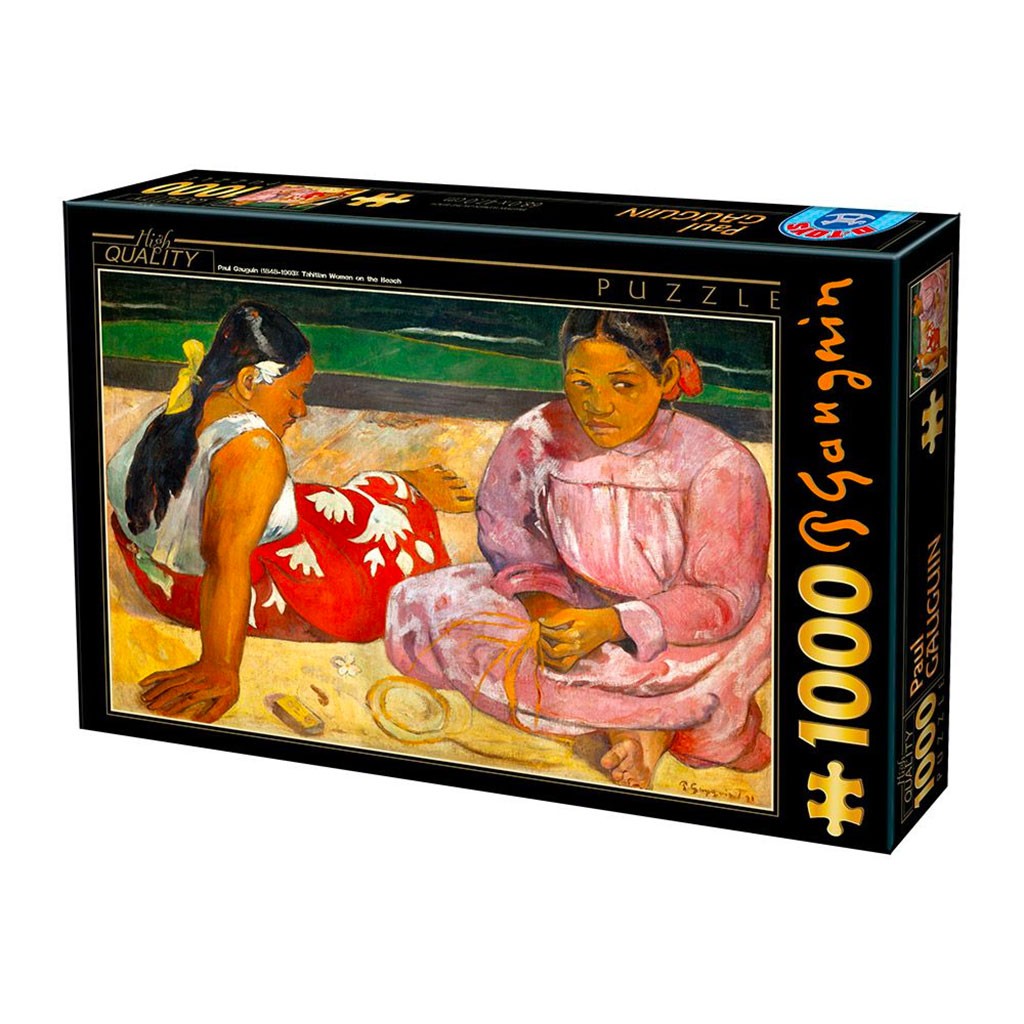

Discover our Gauguin puzzles with us and enter the wonderful world of modern art with the colors and symbols of the great French painter Paul Gauguin.
The art of Gauguin is characterized by a great expressive strength and an unstoppable search for new painting techniques
In fact his travels around the world and the continuous search for new subjects make the art in Gauguin Puzzles a continuous transformation and artistic exploration
By building the Gauguin puzzles piece by piece you will immerse yourself in the world of modern painting and the synthetism of Paul Gauguin.
The life of Paul Gauguin was a perpetual motion between Europe, South America and Oceania.
In fact, born in Paris on June 7, 1848, the following year, after the death of his father, he was already traveling to Peru where he spent his early childhood. After returning to France he studied in Orléans and Paris. In 1865, at just seventeen years old, he began to travel by sea (first as a sailor on a merchant ship, then as a conscript soldier on a cruiser) reaching the most important ports in the world.
In 1871, after his discharge, he settled in his native city working as a stockbroker. In 1873 he married a Danish woman and in 1883 he was forced to leave his job because of the severe economic crisis that France was going through. The event was not so traumatic for Gauguin, who was able to devote himself entirely to painting, an art he had approached in the early seventies, while from 1880 he would participate in all the Impressionist exhibitions.
Desiring a simple, primitive life, free and without constraints, far from suffocating culture, in 1885 he moved to Brittany in Pont-Aven and in 1887 he embarked for Panama and Martinique (an island of the Antilles, a French possession in the Caribbean archipelago).
He returned to his homeland in 1888 and lived for a short time in Arles together with Vincent van Gogh, who dreamed of a community of artists in southern France.
Later he sold all his belongings to move to Tahiti (in French Polynesia, in the middle of the Pacific Ocean) where he remained only two years, from 1891 to 1893. He returned again to Pont-Aven in 1894 and, after putting together a few thousand francs, in July 1895 he left for his last definitive journey to Tahiti and the Marquesas Islands (Polynesia).
Here, for having opposed the racist policies of the French governor, he was
sentenced to prison, where he died on May 8, 1903, desperate, alone, tired and ill.
For Gauguin the first approaches to painting were impressionist (he was a friend of Degas), but already from 1888 his way of painting had completely changed. The colors were applied in large flat areas and, more than complementary colors, Gauguin used primary ones: red, yellow, blue.
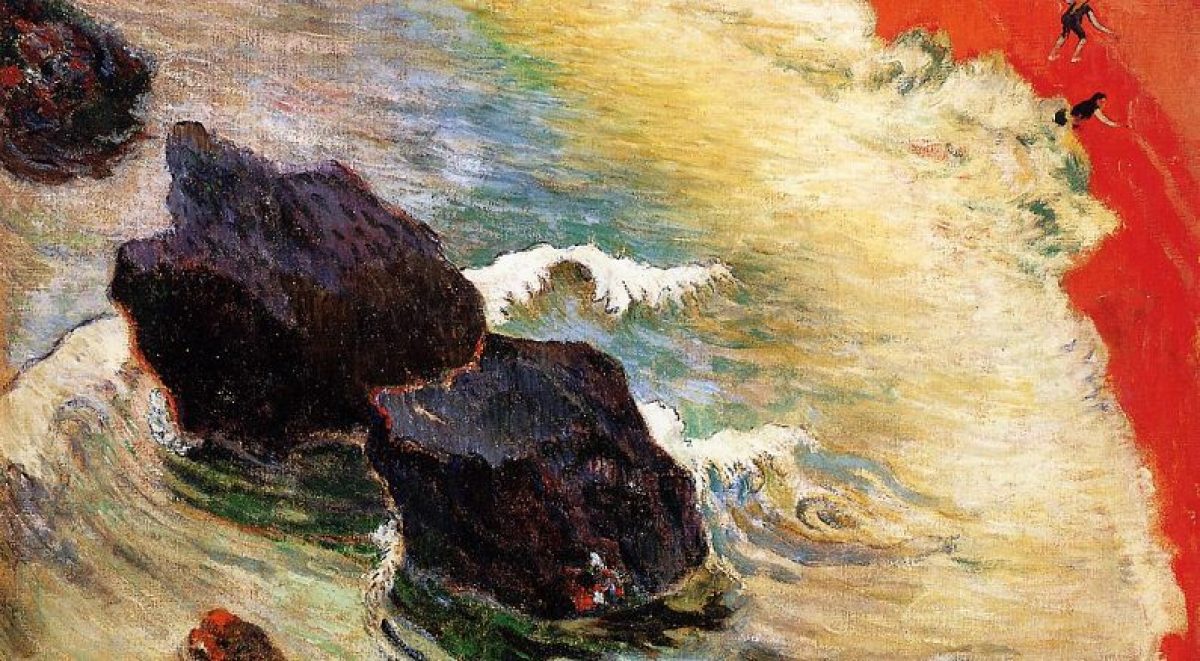
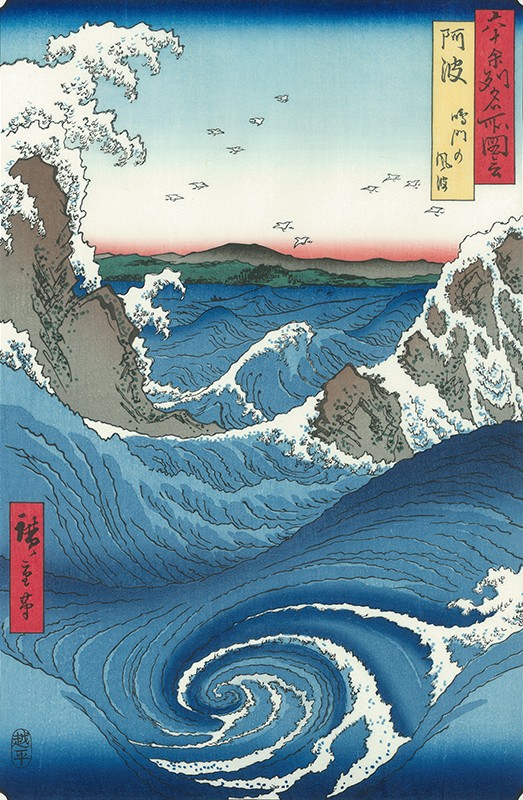
Among the artistic forms to which the painter was sensitive we must certainly include Japanese painting, which was fashionable at the time thanks to the numerous color prints circulating in Europe. An example is The Wave, a painting from 1888 influenced by the creations of the great Utagawa Hiroshige.
As in Japanese prints, the rippling of the waves and the spiral whirlpools, seen from above according to a daring viewpoint, are treated like linear patterns.
In fact, the white fringed foam that laps the rocks (whose position appears geometrically defined following the diagonals of the canvas) is edged with a thin dark line, while wide curves draw the movements of the water between the rocks and the shoreline.
However the beach is red and the water is yellow and green: certainly not natural colors. It is precisely this anti-naturalistic vision that is one of Gauguin’s distinctive characteristics, as he reproduces reality not as he objectively sees it but as he intimately feels it.
Gauguin learned cloisonnism, the technique consisting of outlining objects and painted figures with a strong black line and filling the defined spaces with color, similar to the cloisonné used in multicolored Gothic stained glass and medieval goldsmithing, particularly enamels.
The strong contour line therefore takes on a powerful expressive value, helping to highlight what is painted and, indeed, replacing the spatial values that are almost completely absent in the canvases of Paul Gauguin.
In fact the uniform color, without shading or variations of tone, makes
the painting flat. With Gauguin, therefore, there is the recovery of the two-dimensionality of painting which, at this point, can also do without any perspective illusionism, whether geometric or chromatic.
The Yellow Christ of 1889 is a powerful demonstration of these ideas. The painting depicts Breton women in their traditional costumes, kneeling at the feet of one of the many wooden crucifixes that can still be encountered today in the churches and rural villages of Brittany.
The hills are yellow, the trees have blazing bright red foliage (suggesting the autumn season) and Christ, outlined in black and green, is completely yellow.
The same coloring of Christ and the hills indicates the intimate religious essence of the Bretons and the equal attachment of the women praying around the crucifix to the god-man and to their land.
In this, as in Gauguin’s other paintings, not only can we see the recovery of two-dimensionality, which also benefits from a precise geometric structure (the right margin of the wood of the cross coincides with the midpoint of the canvas, while all the figures are on the left, between the axis and a diagonal), but the importance of color is also clearly evident, because it does not correspond to the objective one.
Along with anti-naturalism and the cloisonnism technique it is also important to emphasize the essential nature of the landscape and the figures with barely sketched features, simplified figures, summarized and synthetic.
Synthetism is in fact the term that Gauguin himself placed alongside Impressionism when in 1889, taking advantage of the Universal Exhibition, he organized an exhibition (which was not successful) of the «Impressionist and Synthetist Group».