
Novità!
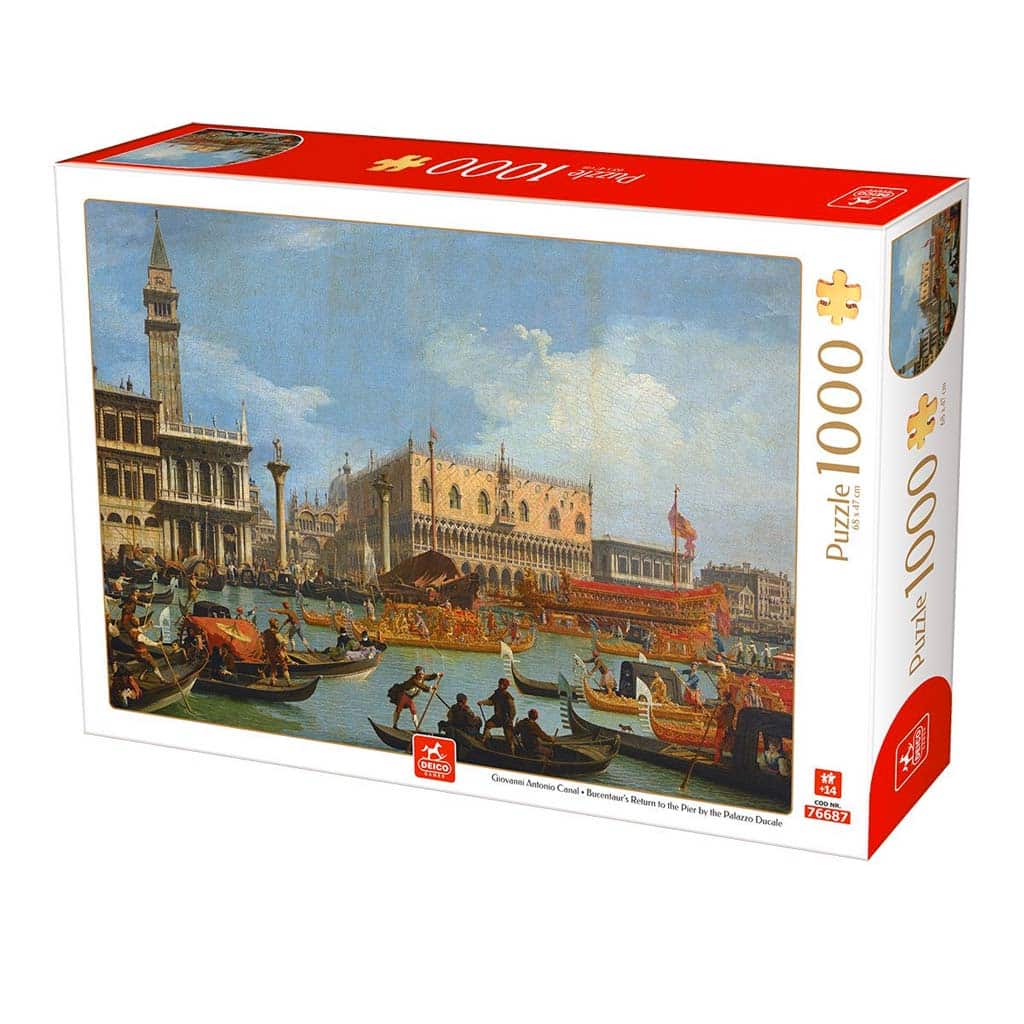
Discover with us our Canaletto puzzles and build piece by piece some of the most evocative Venetian views.
Most Canaletto puzzles depict views. In fact, the painter, a famous vedutist, represented his surroundings with strict accuracy. Using perspective and strictly scientific principles, classics of the Enlightenment, he also painted using the camera obscura.
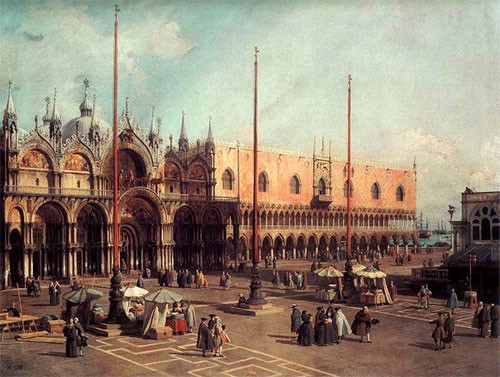
The Canaletto puzzle in our catalog represents one of the most beautiful views of Piazza San Marco.
Giovanni Antonio Canal, called Canaletto, was born in Venice into a family of the Venetian bourgeoisie.
In his time, in the 18th century, he was called “Canal,” “da Canal,” “Antonio Canale,” “Canaletti,” and sometimes “Canaletto.” Today, he is universally known as Canaletto.
He was born on October 17, 1697, in the populous parish of San Lio, and died in his city in 1768, by then famous for his grand city views: especially of Venice, but also of Rome, Padua, and London, where he lived and worked for years.
Antonio Canal’s training began with his father, who guided him onto the path of painting.
Like his father and his older brother, Cristoforo, he began learning painting by working on theater backdrops.
Antonio started collaborating with his father and brother, with his first commissions in 1716, creating backdrops for some works by Antonio Vivaldi.
However, in 1718 the young artist moved with Bernardo and Cristoforo to Rome to create scenes for two theatrical dramas by the master Alessandro Scarlatti.
During his travels, he began his true formation as an independent artist. The trip to Rome was crucial for Antonio as it was there he first encountered vedutist painters.
Three painters of this style became his great masters.
Specifically, his references were: Viviano Codazzi, whom Antonio could not have met alive since he died in 1670, famous for his architectural perspectives and marvelous landscapes with ruins.
The second was Giovanni Paolo Pannini, famous for his fantastic views, many inspired by Roman antiquities. Finally, Gaspar van Wittel, a great Dutch painter, considered among the fathers of vedutismo, known for his attention to detail and the clear descriptive style typical of Northern vedutismo.
Back in Venice, he began his true life as an artist.
However, the life of the Venetian master was not all smooth. Because of his eccentric ways and unyielding character, some wrote that his paintings “stunned” viewers with their precision, while others complained about the high prices.
Among these, in 1736, the Swedish count Carl Gustav Tessin wrote a statement leaving little doubt:
Canaletto, vedute painter, moody, unmanageable, selling a collection painting for up to 120 zecchini, pledged to work only for an English merchant named Smitt. To be avoided.
Canaletto’s paintings are an immense historical resource.
By combining architecture and nature in topographic representation, and through careful atmospheric rendering and precise lighting for each moment of the day, they became a great manifesto of the Enlightenment.
For this reason, Canaletto, emphasizing the scientific value of perspective, sometimes used the camera obscura to paint his works.
Thanks to his remarkable skill and technique, which advanced rapidly, Canaletto soon became one of the most established painters in Venice, and in the late 1720s, his commissions began to increase.
One of his first major patrons commissioned four works from Canaletto, including a view of Campo Santi Giovanni e Paolo.
In 1727, the artist created his first celebratory composition, The Reception of the French Ambassador at the Doge’s Palace, preserved at the Hermitage Museum in Saint Petersburg: the first of a long series of works depicting the festivals of the Venetian Republic.
In this type of painting, Canaletto conveys an image of luxury and splendor in the celebrations of the beautiful city of Venice.
Canaletto is considered one of the most brilliant draftsmen of all time and a key figure in 18th-century landscape vedute.
Many of the best collection sheets were made around 1740 and introduced new lagoon, hill, Venice, Padua, and Roman views, and capricci with ruins.
However, art historians have long noted that Canaletto was not only a painter of “accurate” almost photographic vedute thanks to the camera obscura, but also the imaginative creator of unforgettable “capricci”.
These capricci are perhaps admired today even more than the views, for the incomparable blend of reality and fantasy that Canaletto achieved.
In the Capricci, Canaletto combined real monuments, observed from life but from different locations, with purely imaginary elements. A Palladian temple from Vicenza could appear alongside the Colosseum or the Pyramid of Cestius in Rome, triumphal arches and ruined temples could overlook improbable lakes, and so on.
In London, where Canaletto arrived in 1748 with a letter of introduction for the Duke of Richmond and preceded by his reputation in Venice, he received numerous commissions. There, he captured local atmospheres, interpreting a civilization different from Venetian life.
His works included vast horizons, meticulously described castles, and complex urban scenes that enchanted his patrons with delicate colors.
His stay in England ended around December 1755, when Canaletto returned to Venice, continuing to work on a smaller, more intimate scale.
He drew extensively, especially “capriccios,” creating works such as Architectural Fantasy for his elderly friend and patron Joseph Smith.
Ultimately, his work became a personal study, for pleasure, of light effects, perspectives, and previously painted buildings, now transferred to small, personal and intimate canvases.
He died on October 18, 1768, in his home in San Lio.
Don’t miss the opportunity to enrich your home with a splendid view of Venice typical of Canaletto puzzles. A puzzle every lover of Romantic art and Venice should have in their collection.