

The artist Benozzo Gozzoli was born in 1420 into a Tuscan family and received the name Benozzo Gozzoli from the famous biographer and painter from Arezzo, Giorgio Vasari, who renamed the Tuscan artist in the second edition of his “Lives” (1568).
In 1427, his family moved to Florence, where his professional training began. According to the biography by Vasari, this training may have been under the guidance of the Dominican friar Giovanni da Fiesole, known as the Angelico. He collaborated with him in the early 1440s on the frescoes of San Marco and in decorating the now-lost chapel of San Pietro, as well as Pope Nicholas V’s chapel in the Vatican.
The artistic collaboration with the Angelico ended in 1449, when Benozzo Gozzoli completed the frescoes of the vaults in the Chapel of San Brizio in Orvieto Cathedral.
A year later, the painter moved to Umbria, where the Franciscans commissioned him to decorate the monastery of San Fortunato in Montefalco. There, he was also commissioned to create frescoes depicting the life of Saint Francis for the apse of the church of the same name.
In 1453, he created the now-lost cycle Life of Saint Rosa in the Clarisse church in Viterbo.
He also collaborated with Lorenzo Ghiberti on the doors of the Florence Baptistery, before fully dedicating himself to painting.
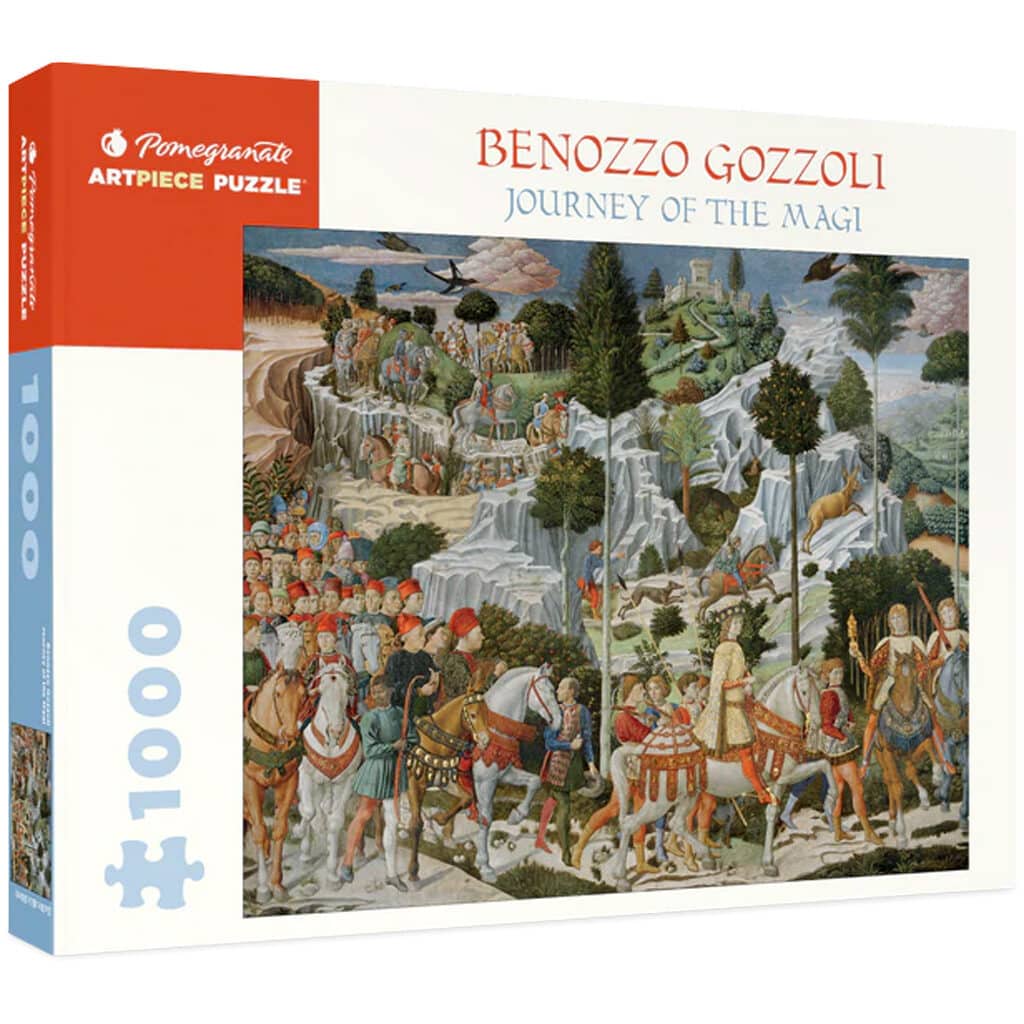
His fame is encapsulated in a single work, one of the most beloved of the Renaissance: The Journey of the Magi.
This masterpiece is located in the Medici Palace Chapel in Florence.
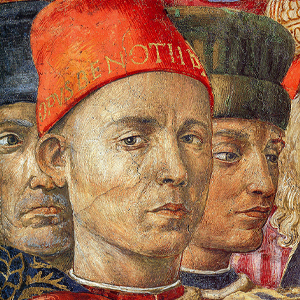
The stunning fresco celebrates Gozzoli’s love for decoration and detail, and also pays tribute to the Medici family, including them in the Procession of the Magi along with a small self-portrait.
In 1467, Benozzo was in San Gimignano, where he frescoed the only known cycle depicting the life of the saint in the church of Sant’Agostino.
Between 1468 and 1494, he worked with his workshop on the Opera della Cattedrale of Pisa, which became more of a business enterprise than purely artistic activity.
Possibly in Pistoia, between 1495 and 1497, Gozzoli completed his last work, the sinopia for the Maestà in the Sala Ghibellina of the Palazzo Comunale.
In 1497, Benozzo Gozzoli died in Pisa, where he is still buried today.